Kimi K3 Floatboat Integration: What It Changes
Kimi K3 is now available in Floatboat. Learn what the 2.8T model adds, where it fits, and how to use it without API-key setup.
Kimi K3 on Floatboat: What the New Model Adds
Most AI tools that support the latest models have a familiar workflow. Find the API key on a settings page. Paste it into a configuration field. Set up billing. Hope you picked the right model. When a new model ships, repeat. That workflow makes sense if you manage infrastructure. It does not make sense if you have meetings to prepare for, deliverables to produce, and follow-ups to send.
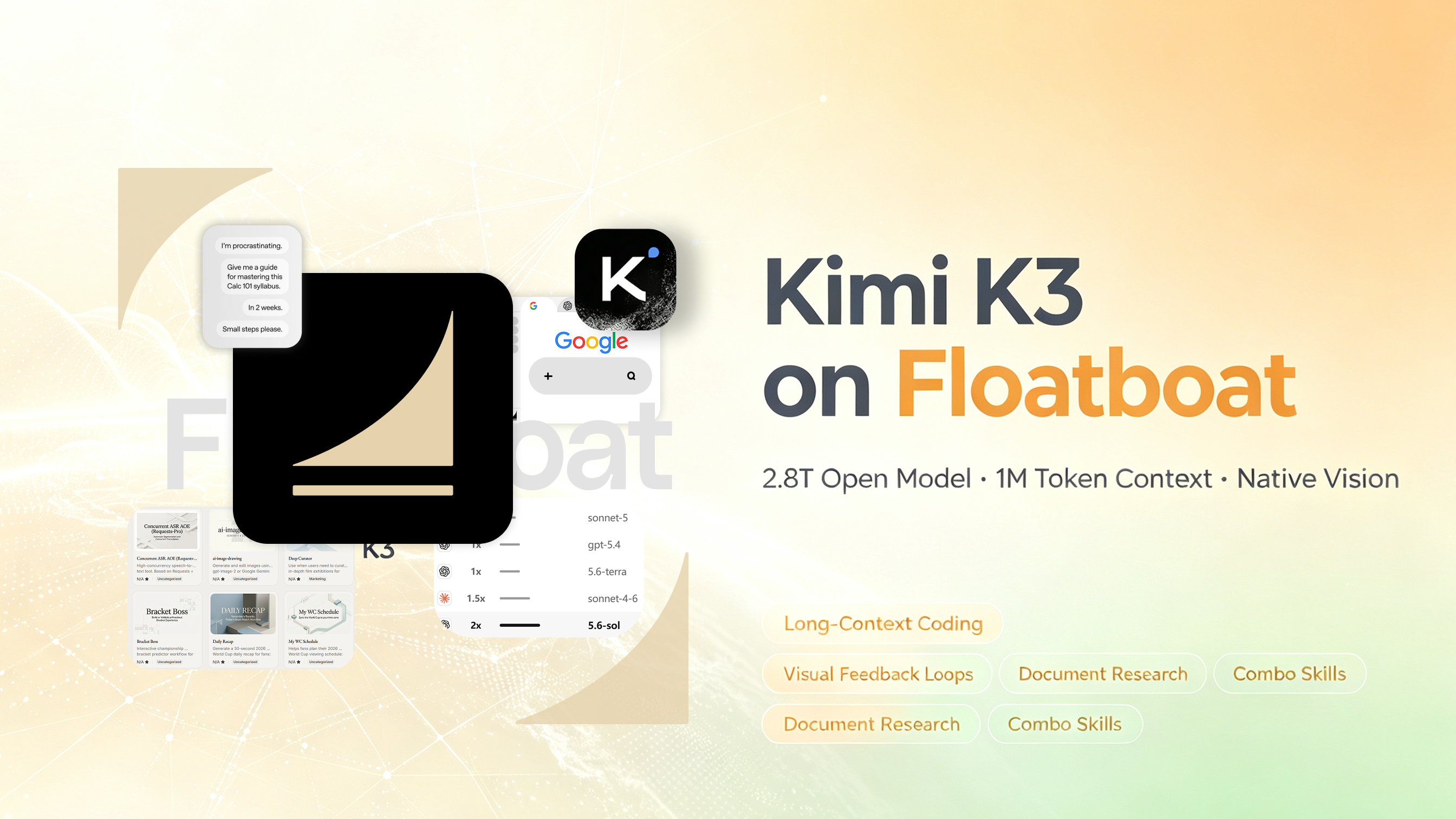
When Moonshot AI released Kimi K3 on July 16, 2026, Floatboat made it available inside your agent workspace without any of that process. No API key. No routing layer. No billing setup. Kimi is one of the built-in model families in Floatboat — alongside DeepSeek, Claude, Gemini, MiniMax, and GLM — and K3 joins the Kimi lineup as a new capability tier that your agents already have access to.
TL;DR
Kimi K3 — Moonshot AI's 2.8-trillion-parameter open model with 1-million-token context, native visual understanding, and always-on thinking — is already built into Floatboat with no API key, no routing setup, and no external account. Full model weights are scheduled for release by July 27, 2026.
Three capabilities map directly to calendar-driven agent work: 1M context for multi-document meeting preparation that previously required sequential calls and intermediate summarization, always-on max reasoning for complex synthesis where the first answer is rarely the right one, and native visual understanding for frontend design and visual feedback loops where code and screenshots iterate together.
Kimi's own technical blog is clear about where K3 stands: overall performance still trails Claude Fable 5 and GPT-5.6 Sol, but K3 demonstrates frontier-level performance across its evaluation suite [Source: <a href="https://www.kimi.com/blog/kimi-k3" rel="nofollow noopener">Kimi K3 Technical Blog</a>]. On Arena AI's Frontend Code Arena — a third-party benchmark ranking frontend code generation by human preference — K3 debuted at #1 with 1,679 points as of the July 17, 2026 snapshot [Source: <a href="https://venturebeat.com/technology/chinas-moonshot-ai-releases-kimi-k3-the-largest-open-source-model-ever-rivaling-top-u-s-systems" rel="nofollow noopener">VentureBeat</a>].
This article maps K3's capabilities to the calendar events your agents already handle, shows what a tiered model strategy costs for a real solopreneur workload, and covers the limitations you should know before switching.
What Is Kimi K3
Kimi K3 is Moonshot AI's most capable model. It uses 2.8 trillion parameters with a Mixture-of-Experts architecture — 16 of 896 experts activated per token — built on two architectural components that Kimi calls Kimi Delta Attention (KDA) and Attention Residuals (AttnRes). The result is a model designed for long-horizon tasks: multi-hour coding sessions, repository-scale analysis, and research workflows that span dozens of documents.
Kimi K3 supports a 1-million-token context window and includes native visual understanding — it can process screenshots, diagrams, and documents alongside text in a single pass. At launch, it runs at max reasoning effort by default; lower and higher effort modes will follow in subsequent updates.
The model is available today through Kimi.com, Kimi Work, Kimi Code, and the Kimi API. Moonshot describes K3 as "the world's first open 3T-class model" and has committed to releasing the full model weights by July 27, 2026. More technical detail will appear in the forthcoming Kimi K3 technical report.
Kimi's official documentation is clear about where K3 stands relative to proprietary models: "While its overall performance still trails the most powerful proprietary models, Claude Fable 5 and GPT 5.6 Sol, Kimi K3 demonstrated frontier-level performance across our evaluation suite, consistently outperforming other tested models." [Source: <a href="https://www.kimi.com/blog/kimi-k3" rel="nofollow noopener">Kimi K3 Technical Blog</a>]
Why Built-In Matters — No API Keys, No Configuration
Floatboat is a proactive agent OS where the calendar acts as the runtime for work. It syncs with Google Calendar, Outlook, Lark, and Notion Calendar, then automatically prepares, executes, and follows up on the tasks inside each event. For more context, see <a href="/blog/what-is-agentic-calendar">what an agentic calendar is</a> and <a href="/blog/calendar-driven-ai-vs-chat-ai">how calendar-driven AI differs from chat-based AI</a>.
The practical difference between integration and built-in is that one keeps you in setup mode and the other keeps you in flow. On platforms where K3 requires configuration, the decision about when to use it is a technical choice you make before starting work. On Floatboat, you open the model selector in any agent pipeline, see K3 listed alongside the other models, and select it — or let Auto Mode route work to K3 when the event complexity calls for it.
The tiered-model approach that Floatboat enables — routing different event types to different models based on task complexity — becomes intuitive after a few uses. Not every calendar event needs K3's max reasoning. Kimi's model family provides a natural three-tier stack: K3 for complex client reviews and multi-document synthesis, K2.7 Code (priced at $0.95/$4 per million tokens) for routine coding tasks and standard follow-ups [Source: <a href="https://www.kimi.com/zh-cn/resources/kimi-k2-7-code" rel="nofollow noopener">Kimi K2.7 Code</a>], and K2.6 for event classification and simple routing. If you prefer not to manage the routing yourself, Auto Mode handles the selection based on event complexity, context length, and timing.
Where K3's Capabilities Fit Best
Kimi K3 is not a general-purpose speed upgrade. It brings three specific capabilities that calendar-driven agents need in different proportions depending on the event. Understanding which capability maps to which event type turns model selection from a configuration decision into a workflow decision.
3.1 1M Context — The Multi-Document Preparation Engine
K3's 1-million-token context window is not just a larger number. It is paired with Kimi Delta Attention (KDA), a hybrid linear attention mechanism that cuts KV cache memory usage by 75% and delivers up to 6.3x decoding speedup at full context length [Source: <a href="https://platform.kimi.com/docs/guide/kimi-k3-quickstart" rel="nofollow noopener">Kimi K3 docs</a>]. The combination means the model can read large amounts of material and reason across it without the latency penalty that typically comes with long-context models.
In calendar-driven terms, the 1M context window handles event types where preparation means synthesizing multiple documents. A client quarterly review that requires reading three previous meeting notes from the event workspace, cross-referencing the CRM for recent interactions, scanning email threads for open items, and generating a structured brief with prioritized talking points and identified risks — this is a 1M-context task. Before models with this context length, the agent had to process documents sequentially, summarize intermediate results, and risk losing information at each compression step. K3 reads everything in a single pass, which means the brief is built from primary sources rather than summaries of summaries.
Kimi's official benchmarks confirm this: on Terminal Bench 2.1, K3 scores 88.3, ahead of Claude Fable 5 at 84.6 and close to GPT-5.6 Sol at 88.8. On SWE Marathon — a test of sustained, multi-step software engineering — K3 leads with 42.0 vs. Fable 5 at 35.0 and GPT-5.6 Sol at 39.0 [Source: <a href="https://www.kimi.com/blog/kimi-k3" rel="nofollow noopener">Kimi K3 Technical Blog</a>, queried July 17, 2026].
3.2 Native Visual Reasoning — Code, Screenshot, Iterate
K3's visual understanding is not a separate module bolted onto a text model. It was trained as a natively multimodal model, which means it can read code, run it, capture screenshots of the output, compare the visual result to the intended design, and iterate — all within the same reasoning loop.
On Arena AI's Frontend Code Arena, a third-party benchmark where human evaluators judge which model produces better functional frontend code from identical prompts, K3 debuted at #1 with 1,679 points, ahead of Claude Fable 5 (1,631) and GPT-5.6 Sol (1,618) as of the July 17, 2026 leaderboard snapshot [Source: <a href="https://venturebeat.com/technology/chinas-moonshot-ai-releases-kimi-k3-the-largest-open-source-model-ever-rivaling-top-u-s-systems" rel="nofollow noopener">VentureBeat</a>]. This is a specific evaluation of frontend code generation (HTML/CSS/JS from natural language), not a general reasoning benchmark.
In Floatboat, visual reasoning maps to any calendar event where the deliverable is visual. A design review on your calendar triggers a K3 agent that pulls the latest mockups, runs the corresponding frontend code, compares screenshots against the design spec, and surfaces discrepancies before the meeting starts. A game dev sprint deadline triggers an agent that tests the build, captures frames, and checks for rendering regressions against the previous version. The visual feedback loop runs without the human needing to switch windows, inspect output, and type feedback — the agent sees the problem and fixes it.
3.3 Always-On Max Reasoning — For When Correctness Dominates Cost
K3 ships with thinking mode permanently enabled and currently supports only the max reasoning effort level — the model allocates its full inference-time compute budget to planning, hypothesis testing, and self-correction before producing the first visible token. Low and high effort levels are planned for future updates [Source: <a href="https://platform.kimi.com/docs/guide/kimi-k3-quickstart" rel="nofollow noopener">Kimi K3 docs</a>].
The trade-off is cost. Simon Willison, an independent AI researcher who tested K3 through OpenRouter, reported that a single "generate an SVG of a pelican riding a bicycle" prompt consumed 13,241 reasoning tokens to produce 3,417 tokens of visible output, costing 25 cents for what was essentially a test prompt [Source: <a href="https://simonwillison.net/2026/Jul/16/kimi-k3" rel="nofollow noopener">Simon Willison</a>]. The takeaway is not that K3 is expensive — it is that K3's reasoning budget should be pointed at tasks where the extra thinking produces output that would otherwise require a human's time.
In a calendar-driven agent, the events that justify max reasoning are the ones where correctness dominates cost. A project retrospective where the agent needs to synthesize feedback from multiple stakeholders, identify patterns across quarters, and produce findings with actionable recommendations — that is a max-reasoning task. A complex negotiation brief where the agent cross-references contract history, market data, and relationship notes to surface risks and opportunities — that is another. For these events, 25 cents of reasoning tokens to save 30 minutes of manual synthesis is not expensive. It is the cheapest part of the workflow.
What K3 Costs in Practice
K3's API pricing — $3 per million input tokens and $15 per million output tokens — makes it the most expensive model ever released by a Chinese AI lab. Cached input tokens drop to $0.30 per million, and Kimi's Mooncake serving architecture, which won the Best Paper award at FAST 2025, achieves over 90% cache hit rates in coding scenarios [Source: <a href="https://news.mydrivers.com/1/1137/1137009.htm" rel="nofollow noopener">快科技</a>]. At that hit rate, the effective input cost is roughly one-quarter of the standard price. For recurring agent pipelines — the same system prompts, tool definitions, and policy documents sent with every request — that discount compounds.
The cost of running K3 matters most when the agent runs continuously rather than on-demand. A solopreneur with 30–50 calendar-driven events per month — client meetings, project deadlines, team syncs, follow-up tasks — will accumulate token usage steadily. The table below shows what different tier strategies cost at moderate usage: roughly 8 million input tokens and 1.5 million output tokens per month, with approximately 4 million tokens eligible for caching.
Strategy | Monthly cost | Notes |
All tasks on K3 | ~$85 | Maximum capability, premium cost |
All tasks on K2.7 Code | ~$23 | Routine work handled well, misses deep reasoning |
K3 (complex) + K2.7 Code (routine) | ~$45 | Complex events get max reasoning, everything else runs cheap |
K3 + K2.7 Code + K2.6 (routing) | ~$55 | Full tier stack: max reasoning, daily coding, event triage |
The recommended configuration — K3 for the handful of complex events each month, K2.7 Code for routine agent work, K2.6 for classification — comes to roughly $55 per month. Running the same workload entirely on K3 would cost about $85. The tiered approach saves roughly 35% while routing the hardest reasoning to the model that can actually handle it. With realistic caching, the $55 estimate could drop to around $40.
Kimi K3's Benchmark Position
Kimi's official technical blog provides a full benchmark table comparing K3 against Claude Fable 5, GPT-5.6 Sol, Claude Opus 4.8, GPT-5.5, and GLM-5.2 across coding, agentic, reasoning, and vision evaluations. Rather than reproduce the full table here (it is available at <a href="https://www.kimi.com/blog/kimi-k3" rel="nofollow noopener">kimi.com/blog/kimi-k3</a>), here is what the data shows:
Kimi K3 is competitive at the frontier. It leads on SWE Marathon, performs at parity with Fable 5 and GPT-5.6 Sol on Program Bench, and trails by small margins on several other coding benchmarks. On reasoning tasks, it scores 93.5 on GPQA-Diamond (vs. Fable 5 at 92.6 and GPT-5.6 Sol at 94.1). On vision tasks, it is broadly competitive with both proprietary models.
It is not the best model across the board. Fable 5 leads on DeepSWE (70.0 vs. 67.5), FrontierSWE (86.6 vs. 81.2), and HLE-Full (53.3 vs. 43.5). GPT-5.6 Sol leads on Terminal Bench 2.1 (88.8 vs. 88.3) and GPQA-Diamond (94.1 vs. 93.5). The pattern is consistent: K3 is in the conversation, not the conclusive winner.
For Floatboat users evaluating whether to switch, here are the factors that matter more than any single benchmark:
Decision factor | What to test |
Code quality | Whether K3's changes fit your repository style and pass your test suite |
Long-context use | Whether the model identifies relevant evidence without losing constraints across a full session |
Visual understanding | Whether screenshot-driven feedback produces accurate UI changes |
Tool use | Whether the model completes multi-step tasks reliably without excessive proactiveness |
Instruction following | Whether requirements remain intact across revisions |
Cost and speed | Whether latency and credit usage fit the task |
What to Know Before Switching
Kimi's official documentation identifies several limitations that Floatboat users should be aware of.
Sensitivity to thinking history. K3 was trained in preserved thinking history mode. If the agent harness fails to pass back all historical thinking content, generation quality may become unstable. Kimi recommends using a harness with verified compatibility and avoiding mid-session model switches. In Floatboat, switching to K3 at the start of a workspace session is recommended over switching mid-task.
Excessive proactiveness. K3's training emphasizes long-horizon, challenging tasks. As a result, it may make unexpected decisions when encountering ambiguous user intent. Kimi's documentation advises imposing explicit behavioral constraints in the system prompt — in Floatboat, this means writing clear Combo Skill instructions and reviewing initial outputs before scaling to recurring workflows.
User experience gap. Kimi's official blog states plainly that "K3 nonetheless exhibits a noticeable gap in user experience compared with Claude Fable 5 and GPT 5.6 Sol." This is not about benchmark scores — it is about the subjective quality of interaction: how well the model understands nuance, when it pushes back on unclear instructions, and whether its output feels polished on the first pass. For Floatboat workflows where polished prose or strategic judgment matters, Claude Fable 5 or GPT-5.6 Sol may still be the better choice.
Conclusion
Kimi K3 adds a meaningful new option to Floatboat's model lineup. It brings a 1M-token context window, native visual understanding, and competitive frontier performance to an open-weight model — and Floatboat users can access it without configuring a separate API key or billing relationship. It is not a universal replacement for Claude Fable 5 or GPT-5.6 Sol. But for the workflows where its strengths align — long-context coding, visual feedback loops, document-heavy research, and structured Combo Skills — K3 is a strong fit.
The practical recommendation is the same as with any model switch: test K3 on your actual tasks, with your actual inputs, against your actual acceptance criteria. Floatboat's model selector makes side-by-side comparison straightforward — run the same Combo Skill on K3 and your current default, then decide based on results rather than benchmarks.
Kimi K3 is live in Floatboat now. Open the app, select it from the model dropdown, and run a task.
FAQ
What is Kimi K3?
Kimi K3 is Moonshot AI's 2.8-trillion-parameter open model, launched on July 16, 2026. It supports a 1-million-token context window, includes native visual understanding, and is designed for long-horizon coding, knowledge work, and reasoning. Kimi describes K3 as the world's first open 3T-class model and has committed to releasing the full model weights by July 27, 2026.
Is Kimi K3 available in Floatboat?
Yes. Kimi K3 is available through Floatboat's model selector without requiring users to configure a separate Kimi API key.
Is Kimi K3 open source?
Kimi describes K3 as an open model and says the full model weights will be released by July 27, 2026. The weights are not yet publicly available as of this writing. Once released, K3 will be the first open-weight model in the 3T-parameter class.
Does Kimi K3 have a one-million-token context window?
Yes. Kimi's official documentation specifies a 1-million-token context window. Kimi K3 operates at max reasoning effort by default at launch, with lower and higher effort modes planned for subsequent updates.
Is Kimi K3 the best coding model?
No single benchmark can determine whether a model is best for every coding task. Kimi's official technical blog shows K3 leading on some coding benchmarks (such as SWE Marathon) and trailing on others (such as DeepSWE and FrontierSWE) compared to Claude Fable 5 and GPT-5.6 Sol. The model that works best for your codebase depends on your repository structure, test suite, toolchain, and acceptance criteria — test K3 against your actual workflow before switching.
Do I need a Kimi API key to use K3 in Floatboat?
No. Floatboat provides built-in model access. Using Kimi K3 in a Floatboat workspace does not require a separate provider API key.
订阅工作流自动化技巧
每周更新一次,无垃圾邮件。