What Is Vibe Coding? Can Solo Founders Ship Faster?
Vibe coding lets anyone build with AI and plain language. Here's what it can do for a one-person company — and where it breaks.131 chars
Hi, I'm Nova. I was reorganizing my bookmarks last week — the usual chaos of tabs I swore I'd "read later" — when I noticed something. Half the tools I'd saved in early 2025 under "interesting AI stuff" were either dead, pivoted, or had a security incident post attached to them.
That's roughly when it hit me: the vibe coding era had a very loud entrance, and now it's having a very quiet reckoning.
I'm not here to declare it dead. But I am here to give you the honest version of what it is, what it actually delivered, and — most importantly — what it means if you're running a one-person operation.
What Is Vibe Coding?
A Plain-English Definition of Vibe Coding
Vibe coding is the practice of building software by describing what you want in plain language and letting an AI generate the code. You don't write syntax. You don't read diffs. You describe an outcome, the AI produces it, you run it — and if it works, you move on.
The name captures the feeling: you're going by feel, not by formula. You're guiding, not engineering.
According to Wikipedia's entry on vibe coding, the practice involves "accepting AI-generated code without reviewing the output thoroughly, instead relying on results and follow-up prompts to guide changes." That's a fair description. It's also exactly what makes it useful for quick experiments and risky for production systems.
Where the Term Comes From
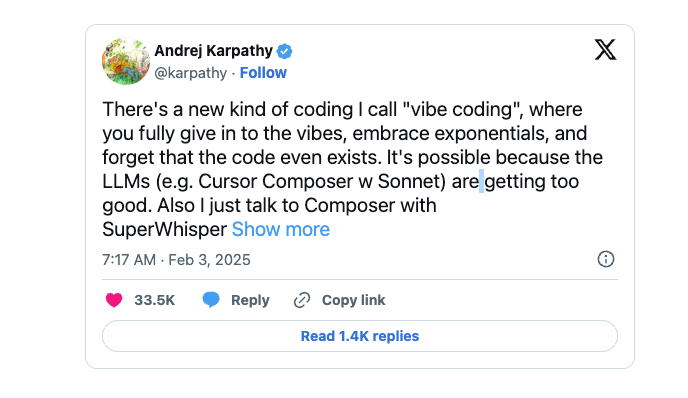
On February 2, 2025, Andrej Karpathy — AI researcher and co-founder of OpenAI — posted on X describing a new kind of coding where you "fully give in to the vibes, embrace exponentials, and forget that the code even exists." He wrote: "I just see stuff, say stuff, run stuff, and copy paste stuff, and it mostly works."
One post. It resonated because it named something a lot of people were already quietly doing. Collins English Dictionary named "vibe coding" its Word of the Year for 2025. Not bad for a tweet.
Why the Term Is Trending
Because it described a real shift. Non-developers — founders, operators, content people — had been using tools like Cursor, Replit, and Claude Code to ship small automations and internal tools. They weren't "programming." They were prompting and accepting. Vibe coding gave that a name, and the conversation exploded from there.
Vibe Coding vs Traditional Development
Natural Language Coding vs Writing Code
Traditional development means owning every line — specific syntax, specific logic, specific debugging. You understand (in theory) what each piece does.
Vibe coding inverts that. As Google Cloud explains in their vibe coding overview, the approach "lets you focus on the desired outcome instead, describing your goal in plain language, while the AI handles the actual code." The primary role shifts from writing to guiding.
Honest version: this works well for simple, contained tasks. It works less well for anything that touches complexity, state, or security.
Speed vs Structure: The Core Tradeoff
Speed goes up — a lot. A solo founder who couldn't previously ship a web tool can now have something running in hours. Structure goes down. The code generated is often functional but fragile: it handles the scenario you tested, not necessarily the one you didn't think of.
I want to be careful not to overstate this. The speed gain is real and meaningful. The tradeoff is also real.
When Vibe Coding Actually Works Better
For throwaway tools, internal automations, quick prototypes to validate an idea before committing to it — vibe coding is genuinely useful. Karpathy originally framed it as good for "throwaway weekend projects." That framing matters. It tells you exactly the use case it was designed for.
How Solo Founders Are Using Vibe Coding Today
Building Internal Tools Without a Dev Team
This is the clearest win. A solo operator who needs a simple dashboard, a lightweight CRM, a Slack notification bot — these are legitimate use cases where vibe coding earns its keep. You're not shipping to customers at scale. You're not handling sensitive data. You just need the thing to work.
I built a content tracking tool with AI assistance last year. It saved me about three hours a week for two months. That's a real number — not a claim I'd make without having used it.
Automating Repetitive Workflows
This is where vibe coding genuinely shines for one-person companies. Connecting a form submission to a spreadsheet update to a Slack notification — tasks that used to require knowing JavaScript — are now promptable. The gap between "I want this to happen automatically" and "this is happening automatically" has gotten very small.
Rapid Prototyping and Idea Validation
Want to test whether a product idea is worth pursuing before spending real time on it? Vibe coding makes that cheap. A Harvard professor who taught a vibe coding course in late 2025 described its core value as changing "the economics of experimentation" — you can build a thing to understand a thing, and you can do it quickly. That framing stuck with me. It's not that vibe coding makes great software. It's that it makes experimentation affordable.
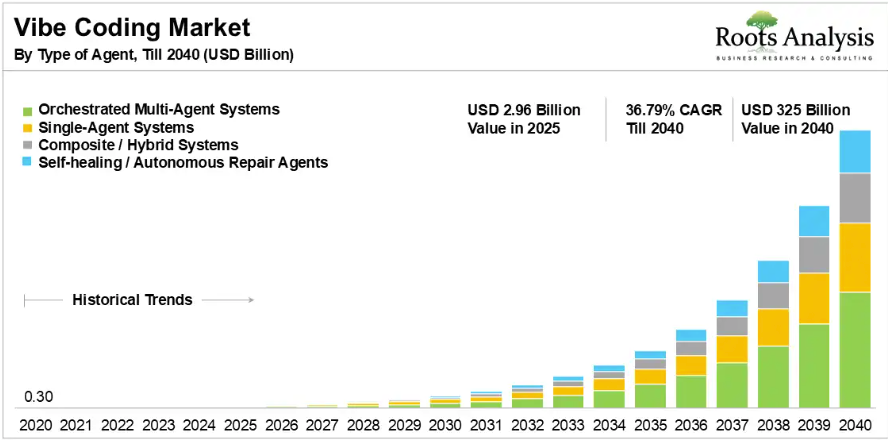
By https://www.rootsanalysis.com/vibe-coding-market
Is Vibe Coding Over? (And Why People Say That)
Where the Backlash Started
On February 8, 2026 — exactly one year after he popularized the term — Karpathy declared vibe coding passé. The New Stack covered his announcement, reporting that he now prefers the term "agentic engineering": "agentic because the new default is that you are not writing the code directly 99% of the time, you are orchestrating agents who do and acting as oversight — engineering to emphasize that there is an art & science and expertise to it."
The backlash from developers had been building before that. By mid-2025, engineers were reporting what Fast Company called the "vibe coding hangover" — teams inheriting AI-generated codebases they couldn't understand, debug, or safely extend.
Common Criticism from Developers
Code churn up 41%. Code duplication increased fourfold. Careful refactoring — the work that keeps codebases healthy over time — collapsed from 25% of changed lines in 2021 to under 10% by 2024. Developer Simon Willison put it plainly: "If an LLM wrote every line of your code, but you've reviewed, tested, and understood it all, that's not vibe coding — that's using an LLM as a typing assistant." The distinction matters.
What "Over" Really Means for Solo Operators
Here's how I think about this. "Vibe coding is over" is mostly a story about professional software development teams shipping production software at scale. For a solo founder building internal tools or testing ideas, the calculus is different. The risk profile is lower. The skill required to use these tools responsibly is more accessible.
That said — the security picture is real and worth knowing about before you ship anything customer-facing.
Where Vibe Coding Breaks Down
When There's No Clear Plan or Structure
The model works with what you give it. Vague prompt, vague output. Unlike a human developer who might push back and ask clarifying questions, AI will produce something plausible-looking that doesn't actually solve your problem. I've generated code that ran without errors and did the wrong thing. After the third time, I started calling that a pattern worth noting.
When Outputs Need Long-Term Maintenance
The bigger problem isn't the first version — it's the fifth. Every prompt-driven iteration adds complexity the AI doesn't fully track. After enough rounds, you can end up with something that technically runs but that no one — including you — fully understands. That's not a foundation you want for anything important.
When Systems Become Too Complex
Security is the clearest example of where vibe coding breaks down. As TechTarget reported on the growing risks of AI-generated code, code churn and duplication are accelerating alongside security debt. OWASP added a dedicated category to its Top 10 in 2025 specifically flagging AI-assisted code defects as a pattern development teams need to address. AI-generated code optimizes for functionality, not security. Those are not the same requirement — and for a solo founder without a security engineer on the team, that gap can surface at the worst time.
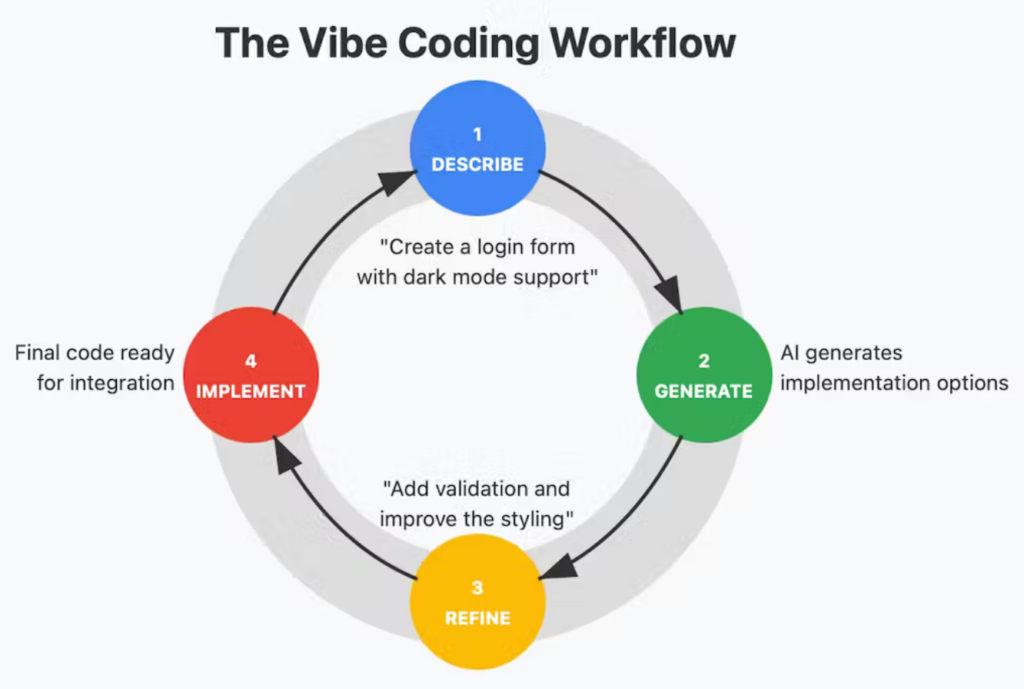
By https://arnaudunjo.com/2025/06/22/vibe-coding-the-immediate-future-of-application-development/
What One-Person Companies Need Instead
From One-Off Outputs to Reusable Execution
Here's the real gap, as I see it. Vibe coding gives you outputs — a script, a function, a small app. What a solo operator actually needs is systems: things that run reliably, can be handed to a collaborator or future-you, and don't break when one piece changes.
The difference between a prompt and a workflow is the difference between asking for directions and having a map.
Why Systems Thinking Matters More Than Prompts
The question isn't "what's the best prompt for this task?" It's "how do I structure my work so this task doesn't keep coming back?" That's an operational question. Vibe coding helps you execute a task once. Systems help you stop needing to do the task manually at all.
Combining AI + Ops + Product Thinking
The solo founders I've seen do this well aren't the best prompters. They're the ones who look at their whole operation and ask: what's actually slowing me down? Then they use AI to address that specific constraint — not to impress themselves with what AI can build.
Vibe Coding vs "Combo Skills" (The Real Advantage)
What Are Combo Skills?
This is where I want to mention something I've been exploring: Floatboat AI, a desktop workspace tool that introduced a concept called Combo Skills.
The idea is structurally different from vibe coding. Instead of a single prompt producing a single output, Combo Skills chains multiple AI capabilities — reading files, analyzing content, generating structure, refining output — into a reusable, repeatable workflow. You build the process once, and it runs every time you need it.
It's closer to building a system than executing a task. That difference is the whole point.
Why Execution Beats Pure Prompting
The gap between a good prompt and a working operation is exactly what vibe coding doesn't solve. A prompt produces something once. A workflow produces it every time, consistently, with the same standards. For a solo operator, the constraint isn't access to AI. It's consistency. Can you reproduce your best work without re-doing it manually each time?
The Skill Stack of Modern Solo Founders
From what I've observed over the past year, the people building sustainable one-person operations aren't choosing between vibe coding and traditional development. They're combining:
AI for speed — prototyping, drafting, automating repeatable tasks
Systems thinking — structuring work so it compounds over time
Judgment — knowing what to review, what to trust, what to question
You can build with AI tools without giving up your understanding of what you're building. That's the actual skill worth developing — not finding better prompts.
FAQ About Vibe Coding
Is Vibe Coding the Same as No-Code?
Not exactly. No-code tools give you a visual interface to build without programming. Vibe coding uses natural language to generate actual code — the output is code, you just didn't write it. They overlap in intent (accessible to non-developers) but are technically different approaches.
Do You Need to Know Programming?
For basic use cases — internal tools, simple automations — no. But the more complex the thing you're building, the more valuable it is to be able to read what the AI produces, even if you didn't write it. There's a meaningful difference between writing code and being able to evaluate it.
Can You Build a Real Business with It?
Yes — with caveats. According to Y Combinator, 25% of startups in its Winter 2025 batch had codebases that were 95% AI-generated. Clearly it's being used for real products at scale.
The honest answer: you can ship fast with vibe coding. Whether what you shipped holds up under real-world conditions depends on how carefully you handled the parts that matter most — security, data handling, edge cases. AI doesn't automatically think about those. You still have to.
I'm still figuring this out, honestly. The tools are moving fast enough that something I wrote about them three months ago would already need an update. What I do feel more certain about: the value isn't in the prompts, it's in the systems. The solo founders building durable operations aren't the ones who found the best AI tool — they're the ones who built workflows that compound over time.
That's one small piece figured out.
Previous Posts:
Get automation tips for your workflow
Weekly insights for non-technical professionals. No spam ever.