
LLM Knowledge Base: Do Solo Operators Actually Need One?
An LLM knowledge base sounds powerful — but is building one the right move for solo operators? Here's an honest breakdown of the trade-offs.
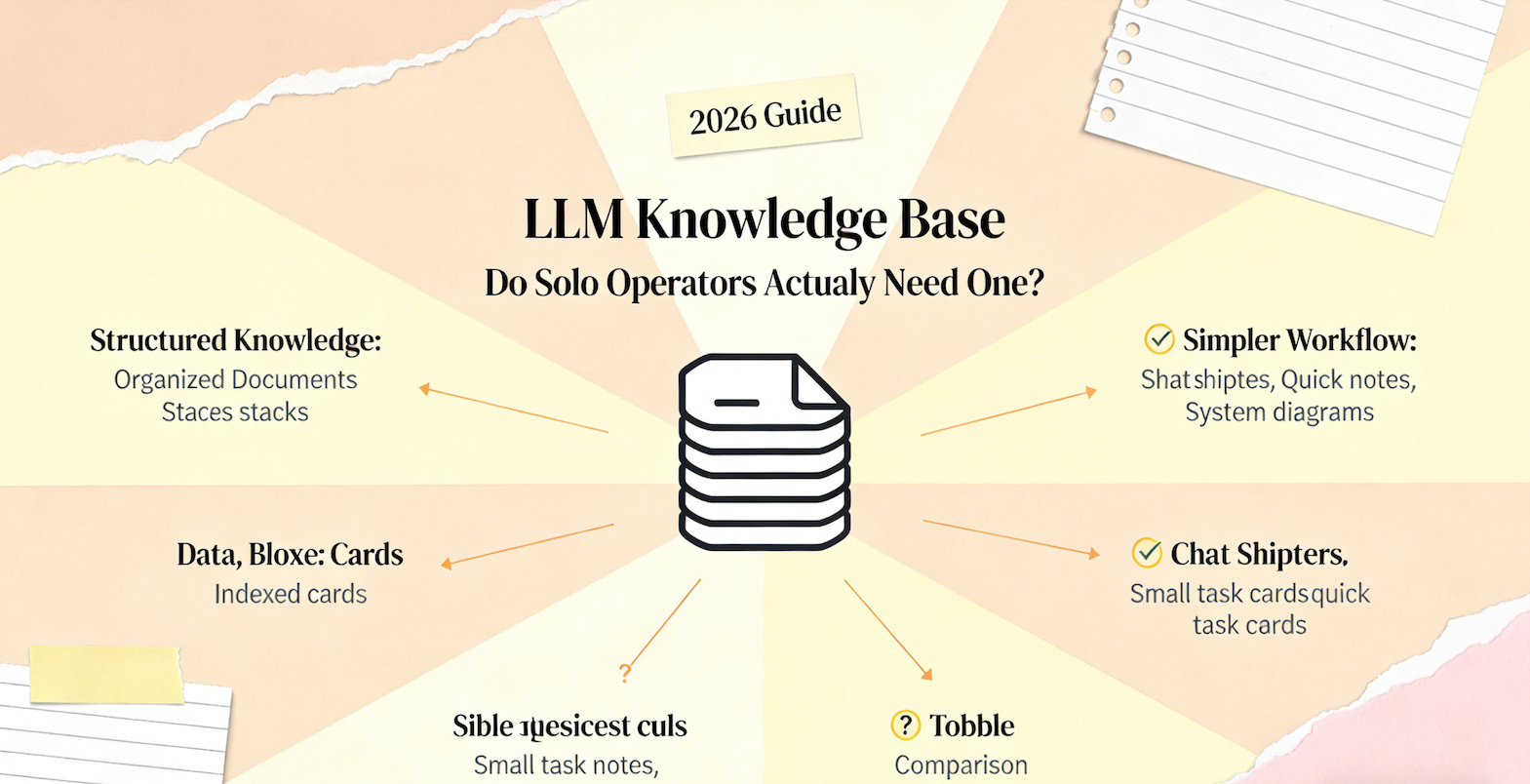
Long time no see. I'm Nova. I was in the middle of a client deliverable when Andrej Karpathy post about LLM knowledge bases hit 1.2 million views. I read it, felt that familiar pull — oh, this is interesting — and spent about twenty minutes genuinely wondering whether I should drop what I was doing and rebuild my research setup.
I didn't. And I've been thinking about why.
If you're running a one-person operation and you saw that post, this article is me working through the actual decision out loud: build it, use a ready workspace, or skip it entirely.
What an LLM Knowledge Base Actually Is
Plain version: you feed raw source material — articles, documents, PDFs, notes — into a folder. An LLM reads all of it and compiles a structured, interlinked wiki. That wiki grows over time. When you have a question, the LLM searches the wiki instead of your memory.
Karpathy's version has grown to roughly 100 articles and 400,000 words on a single research topic — built without him manually writing a word of it.
How It Differs from a Notion Wiki, PKM System, or Plain Note Folder
Your Notion workspace is a place you write things down. An LLM knowledge base is a place the model writes and maintains things, based on raw material you drop in. The key difference is who does the synthesis work.
A PKM system like Obsidian (which Karpathy uses as the reading layer) requires you to connect ideas and revisit notes. The LLM knowledge base removes most of that manual layer — the AI creates backlinks, writes concept summaries, and runs "health checks" to find gaps.

What the Karpathy Workflow Gets Right — and Who It's Actually Built For
Let me be honest about something. Karpathy is a researcher. His job is to deeply understand a narrow technical domain over months, synthesize hundreds of papers, and produce original ideas from that synthesis. An llm knowledge base that grows to 400,000 words on one topic is exactly what someone in that position needs.
He's also, you know, a former OpenAI co-founder and Tesla AI director who probably enjoys configuring CLI pipelines on a Saturday afternoon. He even said in the original post: "I think there is room here for an incredible new product instead of a hacky collection of scripts." He knows this is not a consumer workflow yet.
The Appeal: Why Solo Operators Are Drawn to This Idea
I get it. The core promise of an LLM knowledge base is AI that compounds your knowledge over time. Instead of starting every conversation cold — re-explaining your client context, your niche, your past decisions — the system already knows.
The Promise of AI That Compounds Your Knowledge Over Time
Most of us use AI the same way every day: open a chat, ask something, close the tab. Nothing carries forward. You rebuild context constantly, and that invisible overhead adds up.
The dream version means you stop losing the thinking that accumulates between sessions. Your research doesn't disappear. Your past judgments inform the next one. That's a real problem worth solving. The question is whether building a Karpathy-style system is the right solution for where most of us actually are.
The Real Cost of Building and Maintaining One
Here's where I'd encourage you to slow down before spinning up a folder structure and a prompt chain.
Setup Time, Ongoing Curation, the "Second Job" Problem
[Flag for verification: build time estimates vary widely depending on technical comfort and tooling choices.]
Getting a minimal version working — consistent ingestion pipeline, a reliable compilation prompt, a usable interface — takes real hours. Community implementations that emerged after the Karpathy post suggest setup ranges from a focused weekend to several weeks of iteration before it's stable and trustworthy. That's not nothing when you're already at capacity.
But the setup isn't the hard part. Curation is the ongoing tax.
For the wiki to stay useful, you have to keep feeding it quality material. That means deciding what goes in, what doesn't, when to prune, when to re-run compilation. That decision-making overhead becomes its own workflow — what people in productivity circles call a "second job." The Building a Second Brain community has documented this failure mode for years with simpler note-taking systems. An AI-compiled wiki doesn't automatically make that problem disappear.
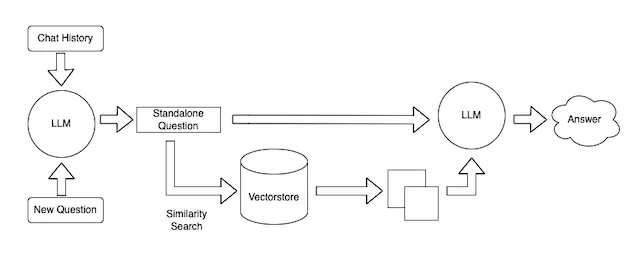
https://blog.langchain.dev/retrieval/
When These Systems Quietly Stop Being Used
I've watched this pattern with complex knowledge systems across different formats. People build them during a productive stretch. They feel good. Then one busy month happens, the ingestion stalls, the wiki goes stale, and the cognitive overhead of maintaining it starts to exceed the benefit of querying it.
The system that requires ongoing attention is the system that gets abandoned first when things get hard. And things always get hard.
What Solo Operators Usually Need Instead
This is the honest part. Most of us don't have a research bottleneck. We have an execution bottleneck.
Execution Memory vs. Reference Memory — Different Jobs, Different Tools
An llm knowledge base is primarily a reference memory system. It's for when you need to retrieve, synthesize, or query knowledge you've accumulated.
What most solo operators actually need is execution memory: the AI equivalent of a colleague who knows your process, your client preferences, your preferred output formats, and can just start rather than needing everything re-explained.
These are different jobs. A wiki answers "what do I know about X?" An execution memory system answers "how do we handle this kind of project, based on how I've handled past ones?"
What Reusable AI Execution Covers That a Personal Wiki Doesn't
Think about the tasks that actually eat your time: writing deliverables that follow your specific format, researching a topic and outputting it in your house style, processing client documents and flagging the relevant parts. A personal wiki doesn't make those faster. What makes them faster is AI, that's embedded in the work itself — that can read a file, draft a response, and iterate, all without rebuilding context every time.
This is why tools in the AI workspace category have started to make more sense for solo operators than DIY knowledge bases. Something like Floatboat takes a different angle entirely — instead of having you build and curate a reference wiki, it learns from your actual working patterns (how you edit, decide, and iterate) and translates that into reusable AI workflows. It's less about storing what you know and more about automating how you work. The distinction feels small but in practice it's significant.
When Building an LLM Knowledge Base IS Worth It
Let me be fair here, because there are real cases where this makes sense.
Deep Research Roles, Long-Horizon Projects, Content-Heavy Businesses
If your work requires synthesizing a large and growing body of domain-specific material over many months — academic research, investigative journalism, highly specialized consulting, building a content business around a narrow vertical — then an llm knowledge base starts to pay off. The break-even point is probably somewhere around "I am regularly frustrated that I can't efficiently query my own accumulated research."
If that's you, the DAIR.AI breakdown of the Karpathy architecture is a solid technical starting point. If you're not sure that's you, it probably isn't.
Decision Framework: Build It, Use a Ready Workspace, or Skip Entirely
Here's the simple version:
Signal | What it suggests |
|---|---|
You regularly synthesize 50+ sources on one narrow topic | Consider building |
Your work compounds over 6+ months in one domain | Consider building |
You're primarily executing repeatable workflows | Use an AI workspace |
You lose context between AI sessions constantly | Use an AI workspace |
You're already at capacity and stretched thin | Skip for now |
You've abandoned a PKM system before | Skip for now |
You don't enjoy maintaining systems | Skip for now |
You just thought "this sounds cool" | Skip for now |
The honest checklist:
Do I have a recurring knowledge retrieval problem (not just a context window problem)?
Will I still be adding material to this in three months?
Do I have 10+ hours for setup and stable ongoing time for curation?
Is my bottleneck knowing things, or doing things?
If you answered yes to the first three and "knowing things" to the last one — this is worth exploring. Otherwise, an AI workspace that learns your execution patterns will probably serve you better.
FAQ
Is an LLM knowledge base the same as a second brain?
Similar idea, different execution. A second brain (per Tiago Forte's framework) is curated manually by you. An llm knowledge base is compiled and maintained by an AI from raw source material — less human curation overhead, but still requires consistent feeding.
Do I need to know how to code to build one?
Karpathy's original setup does. Community implementations are getting more accessible, but you'll hit configuration decisions that require technical comfort. If you're not a developer, this currently involves real friction.
What's the minimum viable version to test whether this fits?
Start simpler than you think. Drop a month's research notes into a folder, run them through a single Claude or GPT-4 session with a compilation prompt, and see if the output is useful. Per Anthropic's prompting documentation, clear structured prompts go a long way before you need infrastructure. If that feels valuable, then invest in a real pipeline.
Isn't this basically just RAG?
The opposite, actually. Karpathy's approach deliberately skips vector database complexity. The wiki is just markdown files . The LLM navigates directly — readable, human-auditable, no embeddings required at personal scale.
I tried a knowledge base before and stopped. Will this be different?
Be honest about why you stopped. If it was curation overhead, an AI-compiled system reduces some of that. If the retrieval wasn't useful enough to justify maintenance, that's a fit problem — and an llm knowledge base doesn't solve a fit problem.
Anyway, that's where I landed. I'm still using Karpathy's post as a thinking tool — but not as a to-do list. If your situation actually fits the deep research profile, it's worth a serious look. For the rest of us: there might be a lighter path that gets you more of the benefit with less of the maintenance tax.
See you next time.
Previous Posts:
Understand whether building custom AI systems actually makes sense for your workflow
Learn how AI agents work before deciding to build your own knowledge system
Explore real AI agent use cases to see where knowledge systems actually add value
See how solo operators use AI tools to execute work instead of just storing knowledge
Understand the difference between AI workspaces and traditional workflow tools
Get automation tips for your workflow
Weekly insights for non-technical professionals. No spam ever.