
Lark CLI: When to Use It (and When Not To)
Lark CLI automates Feishu workflows from the command line—but for solo operators, it's not always worth building. Here's how to decide.
Hi, I'm Nova. Today I will share some new things with you. I was setting up a new workflow last month — nothing complicated, just wanted my Lark messages to feed into a task list automatically. Simple enough request, right? So I started digging into Lark CLI, and two hours later I was knee-deep in App IDs, OAuth redirect URLs, and token expiry logic.
I want to save you that rabbit hole.
This isn't a tutorial. I'm not going to walk you through installation steps. What I am going to do is share what I actually learned about whether Lark CLI is worth building with — especially if you're running things solo.
What Lark CLI Actually Does
Core Capabilities in Plain Terms
Lark CLI is a command-line tool for the Lark/Feishu Open Platform, covering core business domains like Messenger, Docs, Base, Sheets, Calendar, Mail, Tasks, and Meetings — with 200+ commands and 19 AI Agent Skills. That's a lot of surface area.
In plain terms: it's a programmatic way to interact with your Lark workspace from a terminal or from an AI agent. You can send messages, read documents, manage calendar events, query contacts — all via commands rather than clicking through the UI.
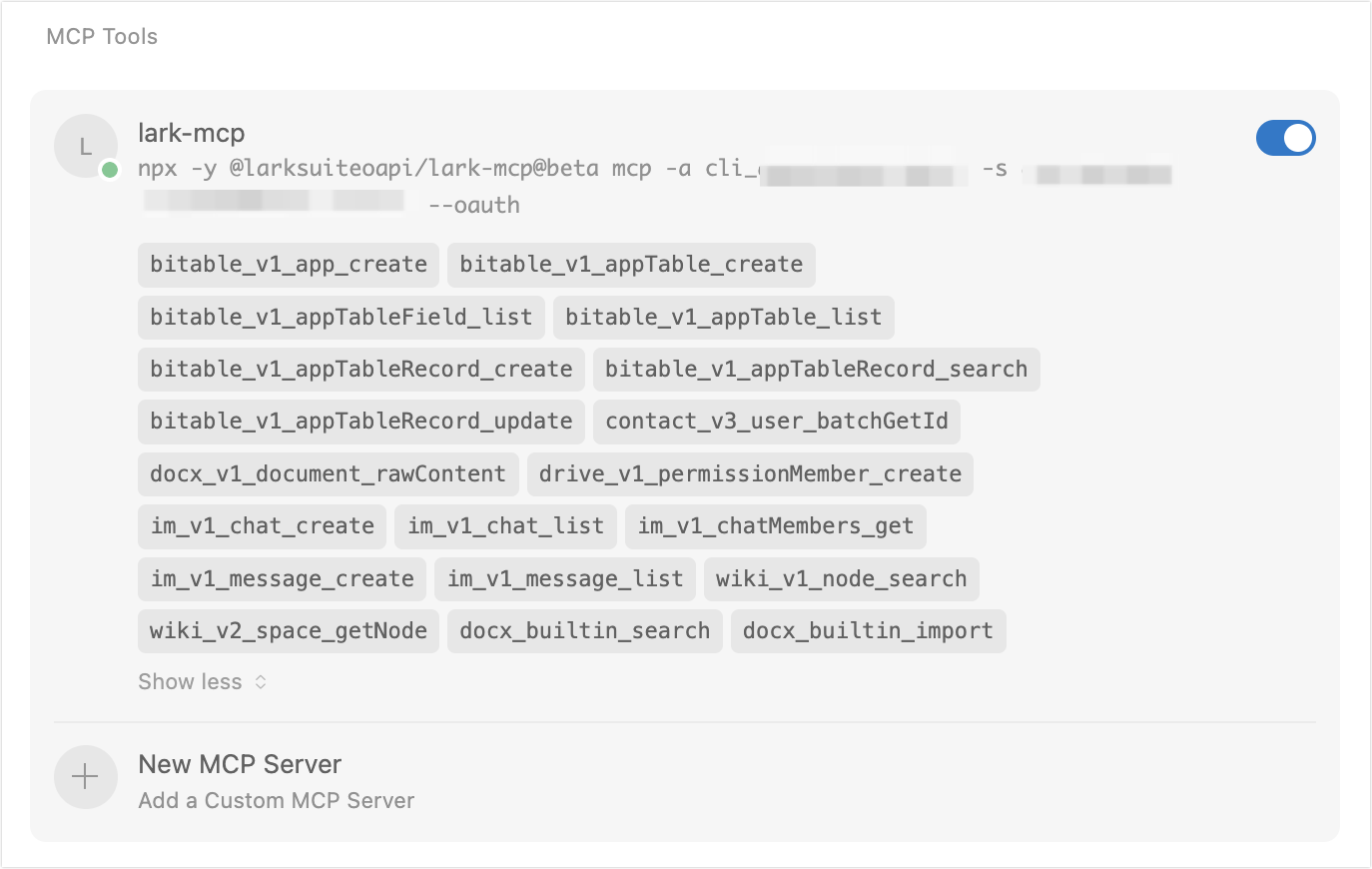
There's also a related tool called lark-mcp, which wraps these same APIs as MCP (Model Context Protocol) tools, allowing AI assistants to directly call Lark interfaces and implement automation scenarios like document processing, conversation management, and calendar scheduling.
Who It Was Built For (Mostly Developers)
Be honest with yourself here. This tooling is built for developers integrating Lark into larger systems — bots, internal apps, automated pipelines. The official Lark Open Platform documentation is thorough, but it assumes you're comfortable reading API reference docs and setting up credential flows.
If your mental model of "integration" is "drag this into that," Lark CLI is probably not your tool. But if you've built a webhook before, it might actually be approachable.
Why Solo Operators Search for It
What You're Actually Trying to Accomplish
Here's what I think is actually going on when someone like me starts looking up Lark CLI: we want Lark to talk to our other tools. We want to stop copying things manually. We want one less tab open.
The underlying goal is almost always one of:
Pull data out of Lark (messages, docs, task updates) and send it somewhere else
Push data into Lark from external systems
Get notified when something specific happens in a Lark channel
Those are reasonable goals. And Lark CLI can technically accomplish all of them. The question is what it costs you to get there.
Common Tasks That Seem Like a Good Fit — But Aren't
This is where people (myself included) get tripped up. Tasks like "send me a Lark message when my form gets a submission" sound like a 20-minute job. They're not, once you factor in:
Creating a Lark app in the developer console (required — you need an App ID and App Secret before anything else)
Figuring out which token type you need (
tenant_access_tokenvsuser_access_token)Handling token expiry —
user_access_tokenhas a validity period of 2 hours and needs to be refreshed periodicallyConfiguring OAuth redirect URLs if your automation needs to act on behalf of a user
Testing, then discovering a permission isn't enabled, then going back to the developer console
None of this is insurmountable. But it's more than one afternoon of setup.
The Real Cost of Building With Lark CLI
Setup and Maintenance Overhead
Let's talk honestly about time. Getting a basic Lark CLI integration running — something that actually does a useful thing reliably — probably takes a competent developer a full day. For a solo operator who isn't primarily a developer, double that conservatively.
Access credentials have a validity period, and developers need to set up business logic to regularly refresh credentials on their own servers to prevent expiration. That means your integration needs to actively manage its own authentication. It's not a set-and-forget situation.
And then there are permission scopes. Some APIs require additional high-level permissions, which need to be configured in the Developer Console and approved before use. If you're building something for a team workspace (even a small one), you may also need admin-level access to approve certain permissions — which, if you're not the workspace admin, means a back-and-forth just to test things.
Task | Time (developer) | Time (non-developer) |
|---|---|---|
Create Lark app, configure credentials | 30 min | 1–2 hours |
Implement token refresh logic | 2–4 hours | Very difficult |
Build first working integration | 4–8 hours | 1–3 days |
Debug first permission error | 30 min–2 hours | Unknown |
Quarterly maintenance (API updates, re-auth) | 1–2 hours/quarter | Higher |
What Breaks When You're the Only One Maintaining It
This is the part that doesn't get talked about enough. Building the integration is the easy part. Maintaining it alone is where solo operators get hurt.
Here's what "maintenance" actually means in practice:
Lark updates their API. Your commands start returning unexpected responses or errors. Nobody's monitoring it. Things silently break.
Your token refresh logic fails during a holiday week. Automations stop. You don't notice until a client asks why they didn't get their report.
You want to hand this off to someone or document it six months from now. You've forgotten what half the configuration does.
This isn't hypothetical. It's the pattern with any custom-built integration that one person built and one person maintains. The bus factor is 1. That person is you.
When Lark CLI Is Worth It
You Have Consistent Dev Resources
If you have a developer — even part-time — who can own this integration and has bandwidth to respond when things break, Lark CLI is genuinely powerful. The GitHub repository for the official Lark CLI is well-maintained, MIT licensed, and the 200+ commands cover almost every Lark use case you can think of.
You Need Custom Deep Integrations No Tool Covers
There are edge cases where no off-the-shelf tool does exactly what you need. If you're building a custom bot that reads from Lark Base, processes data, and posts a formatted summary to a specific channel on a trigger — that's a strong case for going CLI. The flexibility is real.
When It's Not Worth It
You Just Want Lark Context in Your Workflow
If your goal is something like "I want to reference my Lark docs when I'm working in another tool" or "I want my Lark messages to show up somewhere else" — there are lighter paths. Most modern productivity tools support webhooks natively, and Lark's own webhook integration is much simpler to set up than building against the CLI.
A Workspace Tool Already Handles the Connection
Before going the CLI route, genuinely check whether a tool you're already using has a Lark integration. Zapier, Make (formerly Integromat), and n8n all have some level of Lark support. Yes, they're less flexible. But the maintenance burden is theirs, not yours.
Build vs Use: A Decision Framework for Solo Operators
Here's the honest framework I came up with after going down this road:
Build with Lark CLI if:
You or someone on your team writes code regularly
The integration is core to your business, not peripheral
You need something no existing tool provides
You can allocate ongoing time to maintenance
Don't build — use an existing integration if:
This is a "nice to have" workflow, not a critical one
You'll be the only person who can fix it when it breaks
Your time is better spent on the actual work Lark supports
You haven't validated that you need custom behavior yet
The real question isn't "can I build this?" — you probably can. It's "what happens the week I don't have time to fix it?"
What to Do Instead If You're a One-Person Operation
If you're a solo operator and you want Lark to connect to your other tools, here's what I'd actually recommend starting with:
Lark's built-in webhook support — simple, no auth dance, easy to test
Zapier or Make — slower and more opinionated, but you're not debugging token expiry at midnight
AI tools with MCP support — if you're already using an AI assistant that supports MCP, the lark-mcp package on npm is a middle path worth exploring — it's still technical, but designed for AI-assisted workflows rather than raw API scripting
And if you do decide to go the CLI route, start with the official larksuite/cli on GitHub rather than third-party forks. It's actively maintained and the issues list is a good signal of what real users are running into.
FAQ
Do I need an enterprise account to use Lark CLI?
Not necessarily — you need to create an app in the Lark Developer Console, which is available to standard accounts. However, some API permissions may require workspace admin approval, which can create friction in shared workspaces.
How often do Lark CLI integrations break?
It varies, but token expiry is the most common quiet failure point. If you're not building in automatic refresh logic, expect things to stop working every couple of hours without warning.
Is Lark CLI the same as the Lark MCP tool?
They're related but different. The CLI (larksuite/cli) is a command-line tool for humans and agents. The MCP tool (lark-mcp) is specifically designed to wrap Lark APIs for AI agents using the Model Context Protocol. If you're working with AI tools like Cursor or Claude, lark-mcp is the more relevant path.
Anyway, that's what I actually learned from this particular rabbit hole. If you're seriously considering the CLI path, it's worth it to spend 30 minutes reading through the developer documentation before committing. Sometimes the answer is "yes, build it." More often than I expected, the answer is "there's a simpler way that breaks less."
Back to building things.
Previous Posts:
Explore the pros and cons of building custom AI agents vs using pre-built platforms
Learn more about Lark integrations and alternatives to build smarter workflows
Check out alternatives to Gumloop for your AI workspace needs
Discover the best AI agent development services for customized needs
Find out how workflow builders compare to AI workspaces for integrating tools like Lark
Get automation tips for your workflow
Weekly insights for non-technical professionals. No spam ever.