
Genspark vs Manus: How They Compare
Genspark vs Manus compared directly — what each one does, where they differ, and which fits your workflow better.
Hey, Nova is here. I've been watching people debate Genspark vs Manus in my feeds for a while now, and honestly? Most comparisons I've read treat them like they're basically the same thing. They're not. They solve different problems, for different kinds of people, at different levels of trust you're willing to extend to an AI.
I've spent time inside both. Here's what I actually think.
What Genspark Is Built to Do
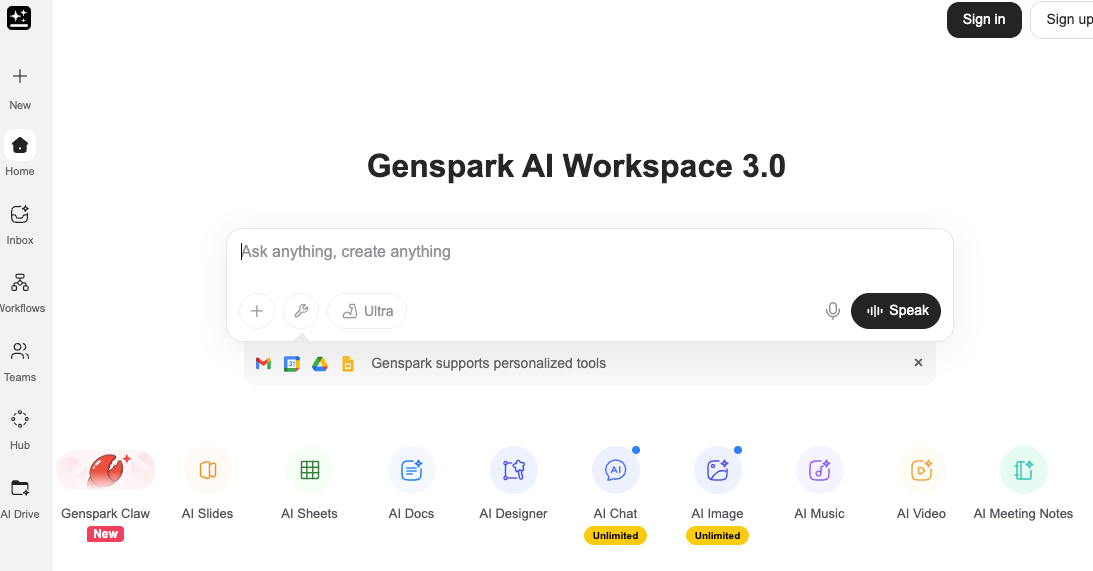
Genspark started as an AI search tool and evolved into something closer to a multi-agent content workspace. The core product today is its Super Agent — a system that takes your prompt, assigns sub-tasks to specialized agents (research, slides, spreadsheets, image generation), and delivers a structured output called a Sparkpage.
What makes it distinct: it runs multiple AI models in parallel — GPT, Claude, Gemini — and has them cross-check each other before surfacing results. That's useful when you need research you can trust a little more than a single model's confident guess. There's also a "Call for Me" agent that can literally make phone calls on your behalf for simple tasks like reservations or confirmations — one of those features you raise an eyebrow at, then use twice, then can't imagine not having.
Pricing: Free plan gives you 100 credits/day. Plus plan is $24.99/month and includes 10,000 monthly credits, 50 GB storage, and unlimited AI chat with top-tier models like GPT-5.1, Claude Opus 4.5, and Gemini 3 Pro. Pro is $249.99/month for agency-level usage.
Where Genspark sits in your workflow: think of it as a research-and-create tool. You bring it a topic or a task, it produces a finished or near-finished asset. The interaction is mostly directed by you.
What Manus Is Built to Do
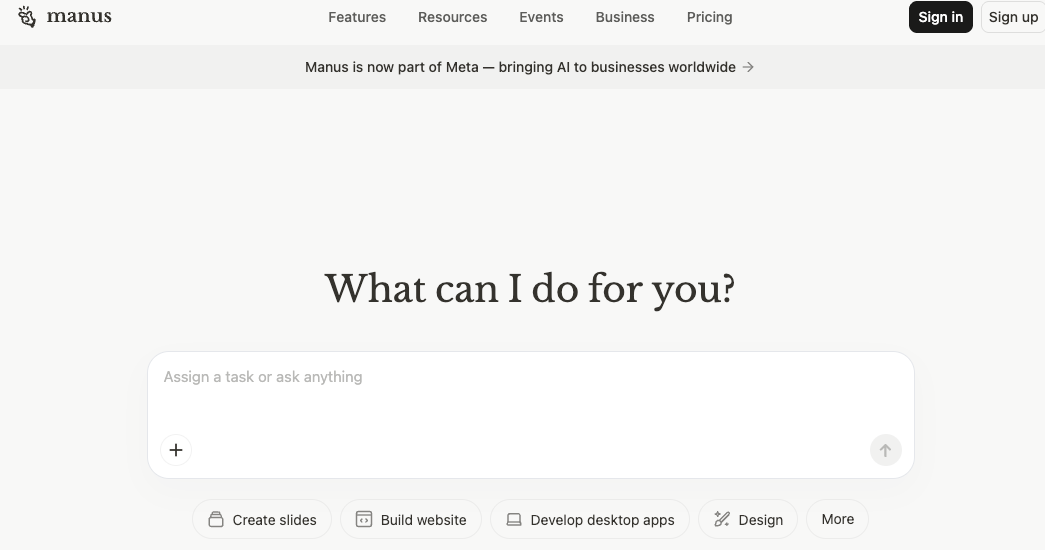
Manus is a different category of thing. Manus is not ChatGPT. It's not Claude. It's something fundamentally different — an AI that doesn't just talk, it does.
VentureBeat described Manus as a major advance because it could autonomously handle complex tasks, including writing and deploying code. You give it a goal — "research my top five competitors and build a presentation" — and it goes away, browses the web, writes code if needed, manages files, and comes back with a deliverable. You don't prompt it every step. That's the whole idea.
One notable development: in December 2025, Meta acquired Manus for an estimated $2–3 billion. Meta said it would continue to operate and sell the Manus service — but it's now technically a Meta product in transition, worth knowing if that affects your data comfort level.
Manus utilizes several AI agents that work together, each specialized in tasks such as browsing the web, analyzing data, or writing code. It can also call different models, such as Claude or Qwen, selecting the best one for each step.
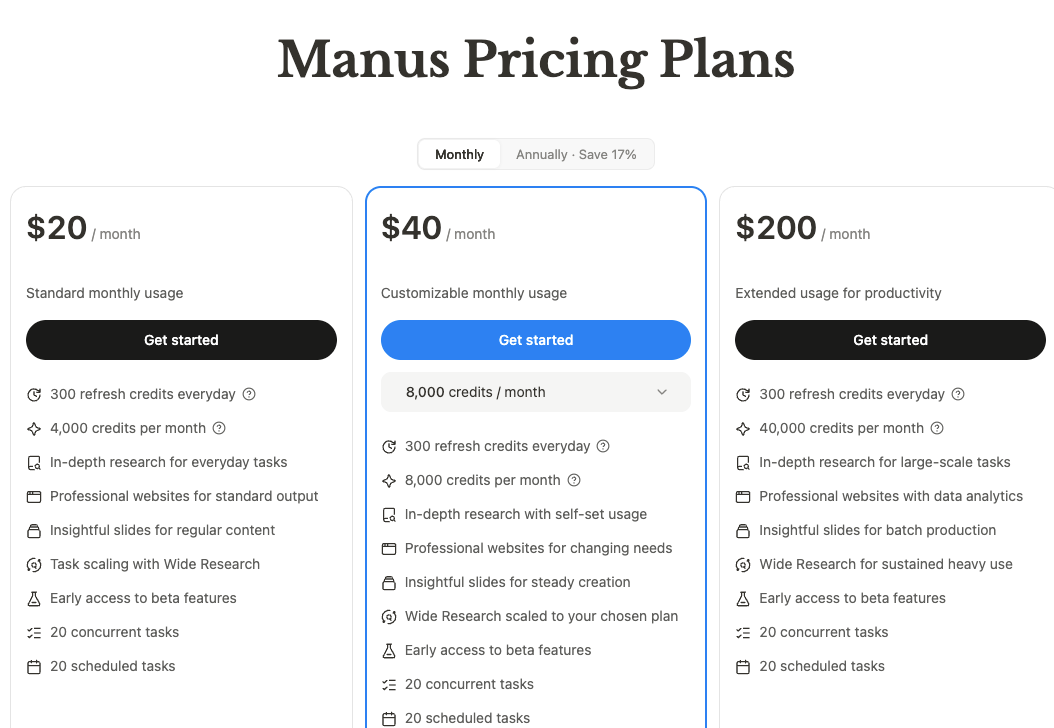
Pricing: Free plan gives you 300 daily credits and 1,000 starter credits. Paid plans start at $20/month for Standard. The credit model is highly unpredictable — users report that complex tasks can quickly consume a significant number of credits, with no upfront estimate for usage.
Where Manus sits in your workflow: it's less of a tool you use and more of a system you delegate to. That's powerful, but it also means you need to think carefully about what you hand off.
Key Differences Side by Side
This is the section I wish existed in every comparison I've read. Here's the honest version:
Category | Genspark | Manus |
|---|---|---|
Task scope | Research, content creation, slides, spreadsheets | Multi-step autonomous execution: code, browse, deploy, analyze |
Autonomy level | Directed — you guide the task | Agentic — you set a goal, it figures out the steps |
Context handling | Session-based, Sparkpages as output | Persistent memory across sessions |
Pricing | Free / $24.99 / $249.99/mo | Free / $20+/mo (credit-based, unpredictable) |
Ideal user | Researchers, content creators, solopreneurs needing fast structured outputs | Power users comfortable delegating complex workflows end-to-end |
Ownership | Independent | Acquired by Meta, Dec 2025 |
The biggest practical difference is how much you stay in the loop. With Genspark, you're steering. With Manus, you're delegating. Neither is wrong — they're just different relationships with an AI tool.
Where Genspark Is the Stronger Choice
Genspark pulls ahead when you need structured, verifiable content outputs fast. If you're regularly producing research briefs, slide decks, competitor analyses, or multi-source summaries, the Sparkpage format is genuinely useful. It includes citations, lets you fact-check slides with one click, and keeps everything inside one workspace.
It's also just more predictable. You know roughly what you'll get, the interface is clean, and the free plan is generous enough to actually test it properly before committing. For solo creators or small teams doing content-heavy work, the $24.99 Plus plan covers most daily needs without the credit anxiety that users report with Manus.
One more thing: Genspark's mixture-of-agents architecture — where multiple models fact-check each other — is a genuine differentiator for research quality. Not perfect, but more grounded than a single-model answer.
Where Manus Is the Stronger Choice
Manus earns its place when the task is genuinely complex, multi-step, and would take you a long time to do manually. From testing, Manus AI excels at research-intensive tasks, competitive and academic analysis, complex planning, and recurring administrative work — gathering and synthesizing information from multiple sources, remembering past preferences across sessions, and producing structured, editable outputs.
The background operation capability is real and useful — you can kick off a task and come back to a finished output, rather than babysitting the AI through every step. For someone running a one-person operation across many roles, that shift from tool to assistant genuinely changes how you work.
It also writes and deploys code. If you need a working web page or a prototype generated from a prompt, Manus handles that in a way Genspark simply doesn't.
The Wikipedia page on Manus AI has a solid overview of the architecture and acquisition context if you want the full backstory.
What Both Tools Still Don't Do Well
This is the credibility section. Both tools have real limitations and most reviews gloss over them.
Genspark's weak spots:
Credit depletion is faster than expected. Complex tasks burn through credits quickly. The 100/day free limit barely handles one serious research task.
Billing and support issues show up repeatedly in user reviews. Not a dealbreaker, but worth knowing before you enter payment details.
Sparkpages are excellent for research but aren't a full workflow automation system — you're still doing a lot of the connecting work yourself.
Manus's weak spots:
Cost unpredictability is a legitimate problem. A complex research task can consume 500–900 credits. With the free plan, you'll get through one demanding task per day at most.
Tasks occasionally fail mid-way and credits are still consumed with no refund mechanism.
Meta acquisition creates legitimate uncertainty. Data flows through Meta's infrastructure now, which matters if you're handling anything sensitive.
It's impressive but not always reliable. "Manus is the impressive intern who can do surprisingly much — but you should still look over their shoulder" is a fair characterization.
Both tools are moving fast. Features and pricing have changed significantly even in the past few months — so always verify current plans directly on their sites before making a decision. You can also check Product Hunt's listings for both tools for real user reviews that are more up-to-date than most blog posts.
How to Decide
Honestly, this comes down to one question: do you want to stay in control of the process, or delegate the whole thing?
If you're a content creator, researcher, or solo founder who needs fast, structured outputs and you want to see what's being generated at each step — start with Genspark. The free tier is usable, the Plus plan is reasonably priced, and the Sparkpage format works well for the kinds of tasks most solo creators do daily.
If you regularly tackle complex, multi-step projects — competitive research, site builds, deep analysis — and you're comfortable with some unpredictability in how credits are consumed, Manus is worth exploring seriously. Just go in knowing the credit system requires tracking and that you're now working within Meta's ecosystem.
And if you're genuinely unsure — run both free tiers on the same task. The difference will be obvious within twenty minutes.
FAQ
Is Genspark or Manus better for research?
For structured, citation-backed research outputs, Genspark's Sparkpage format is strong. For deep autonomous research on complex topics where you want Manus to browse, synthesize, and deliver a report without you guiding it, Manus handles it better.
Is Manus still independent after the Meta acquisition?
Manus continues to operate as a standalone service at manus.im with its own subscriptions. Meta plans to integrate the underlying technology, but the product remains available directly.
Which is cheaper to use regularly?
Genspark's Plus plan at $24.99/month is more predictable. Manus starts at $20/month but credit consumption on complex tasks can make it more expensive in practice.
Do both tools work without any coding knowledge?
Yes. Both are designed for non-technical users. Manus can produce code as an output, but you don't need to know how to code to use either tool.
Anyway — these are two tools I keep coming back to, for pretty different reasons. Genspark is the one I reach for when I need something well-structured, fast. Manus is the one I give the harder, messier tasks to.
If you're curious, the free tiers on both are genuinely usable. Worth a try.
Previous Posts:
Compare different Manus AI alternatives and what each tool does better in real workflows
Break down Genspark pricing, credit usage, and whether the plans are actually worth it
Explore real-world AI agent use cases to see where autonomous tools like Manus actually shine
See how solo creators structure workflows and delegate work using AI agents in practice
Get automation tips for your workflow
Weekly insights for non-technical professionals. No spam ever.