Custom AI Agent Development: When Does It Make Sense?
Custom AI agent development isn't always the right answer. Here's what it actually involves, what it costs, and how to decide if it's worth it for your situation.
Long time no see! I'm Nova. I've spent the last year deep in the AI tools space — testing no-code workflow builders, poking around agent frameworks, watching how solo operators and small teams actually adopt this stuff. And one question keeps coming up in every founder forum and creator community I'm part of: "Should I just hire someone to build me a custom AI agent?"
Most of the content answering that question is written by agencies that build custom AI agents. Surprise. So I wanted to think through it more honestly, as someone who experiments with these tools daily and watches what actually works — and what quietly drains budgets.
This isn't a sales pitch in either direction. It's a thinking framework to help you figure out whether custom AI agent development is actually what you need, or whether you're about to spend $40,000 solving a $40/month problem.
What Custom AI Agent Development Actually Involves
Before you can make a good decision, you need to know what you're buying. The term gets used loosely, and that looseness costs people money.
Scoping and Requirements
This is the part that tends to get glossed over in the early excitement. A real scoping process means documenting — in very specific terms — what the agent needs to do, what systems it connects to, what "success" looks like, what edge cases matter, and what happens when it fails. If you can't answer all of those questions clearly, the development process will expand to fill your uncertainty. Developers charge for ambiguity, and they should — it's genuinely harder to build.
The scoping phase alone for a mid-complexity project can take 2–4 weeks and represent 15–20% of total project cost. Skipping it is where most budget overruns begin.
Build vs. Configure vs. Integrate
There's a spectrum that most people don't fully appreciate:
Full custom build: Engineers write agent logic from scratch, typically using frameworks like LangChain or LangGraph for orchestration, tool use, and memory management. Highest cost, highest control, highest flexibility.
Framework-based configuration: Building on top of existing AI platforms with custom code layers and API integrations. Lower cost than full custom, still requires real engineering.
Integration and workflow work: Connecting existing tools in complex ways that a generalist might call "custom development" — but is fundamentally different from the first two.
Understanding which bucket your project actually falls into is the first thing worth clarifying with any vendor.
Deployment and Handoff Expectations
Building the agent is one phase. Deploying, monitoring, and maintaining it is an ongoing cost center. Who owns the system after launch? Who debugs it when the underlying model updates and behavior drifts? What's the SLA if it goes down during a critical workflow? These questions are easy to skip in the excitement of planning — and painful to answer after you've already paid.
Get these in writing before you sign anything.
What Drives the Cost Up or Down
Complexity of Integrations
This is the single biggest cost driver, consistently. Connecting an agent to a clean, modern REST API is relatively straightforward. Connecting it to a legacy CRM, a proprietary internal database, or a system with inconsistent authentication? That's where projects blow past budget.
Based on publicly available pricing data from AI development firms in 2025–2026:
Single-purpose automation agents (one task, one system): $5,000–$15,000
Multi-step reasoning agents with tool integration: $20,000–$80,000
Multi-agent systems with custom training and enterprise integration: $100,000–$500,000+
These ranges are consistent across multiple independent analyses of 2025–2026 project data, including detailed case studies published by development teams covering real client engagements.
Maintenance and Support Requirements
According to the 2025 State of AI Cost Management Report, 80% of enterprises underestimate their AI infrastructure costs by more than 25% — typically because they focus on development budgets while overlooking the cost of keeping the agent operational.
API costs alone (for commercial models like GPT-4o or Claude) can run $100–$1,000+/month for moderate-use agents, scaling up significantly with query volume. Add hosting, vector database storage for memory, monitoring tooling, and periodic tuning — and ongoing costs typically land between $500–$5,000/month depending on complexity. This isn't optional maintenance. AI systems drift in ways traditional software doesn't, requiring active attention.
When Custom Development Is the Right Call
High-Complexity, High-Specificity Requirements
There are genuine situations where off-the-shelf tools can't get you there. Highly regulated environments (healthcare, legal, financial services) where auditability and compliance are non-negotiable. Workflows involving proprietary data that can't leave your infrastructure. Decision logic sufficiently unusual that no template comes close.
The clearest signal: you've already tried configuring existing tools and hit real walls. Not hypothetical walls based on reading feature lists. Actual walls encountered during hands-on testing. If you haven't tested the alternatives, you're not ready to have the custom development conversation.
Deep Integration Needs That Off-the-Shelf Tools Can't Cover
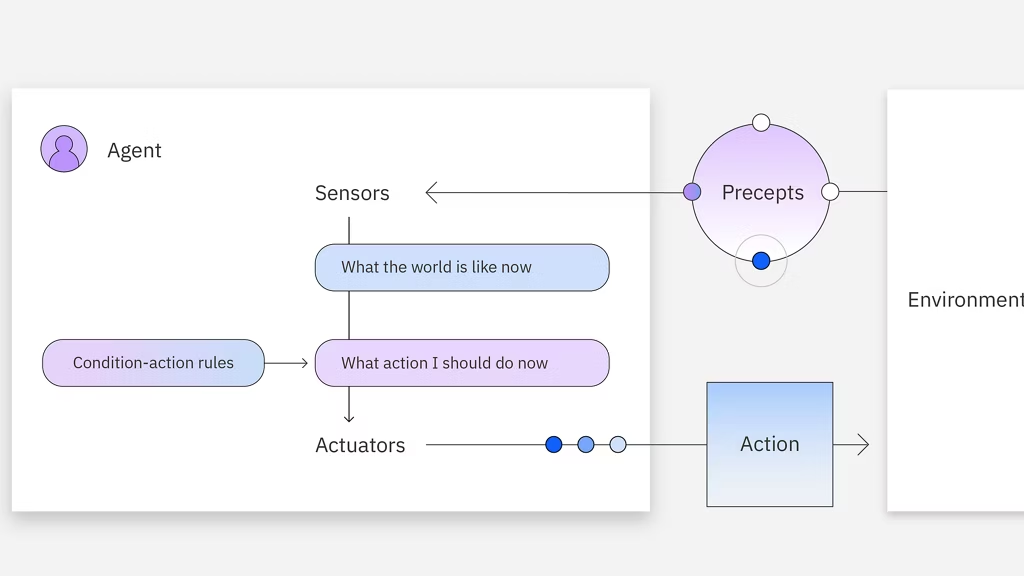
Some businesses run on internal systems that simply don't have clean APIs — or need an agent coordinating across six or seven tools in ways that no visual workflow builder handles reliably. According to IBM's overview of AI agents, the most valuable agent deployments tend to be ones deeply embedded in specific operational contexts — which often requires custom work by definition. The most complex agentic systems — multi-agent architectures with custom training and enterprise integrations — can run $100,000 to $500,000 or more, but for the right use case, the ROI math can support it.
If a custom agent saves your team 20 hours/week at $75/hour, that's roughly $6,000/month in recovered capacity. A $60,000 build pays back in 10 months. If it saves 3 hours/week? Math falls apart entirely.
Do the break-even calculation before the vendor conversation.
When It Probably Isn't Worth It
This section deserves equal space to the case for building — because the honest answer is that most people asking about custom AI agent development don't need it. I've watched this play out in real time across multiple communities, and it's consistently the same story.
When Your Use Case Is Already Covered by Existing Tools
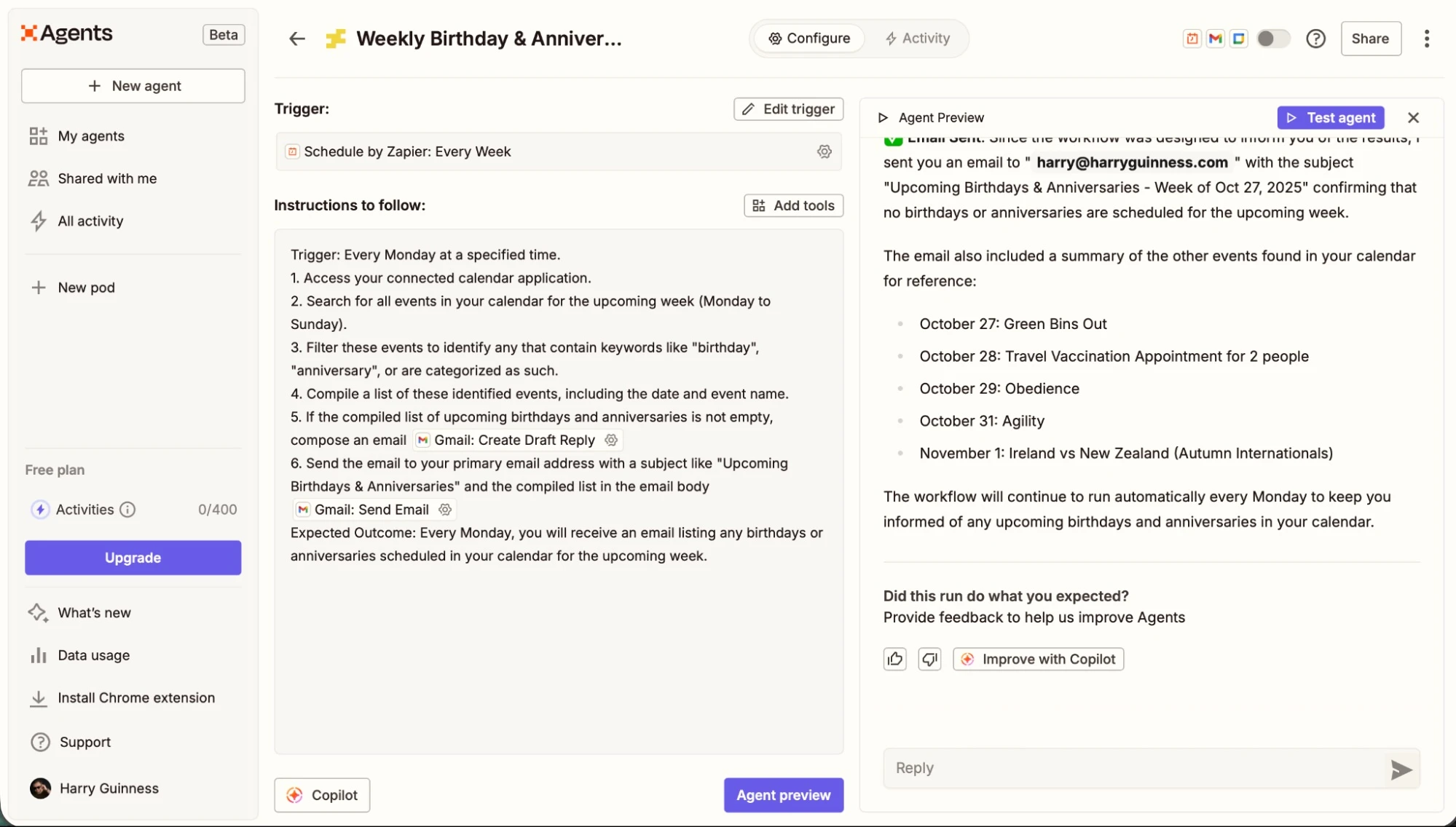
The no-code AI agent space has moved faster in the last 18 months than most people track. Zapier's AI agent capabilities now let non-technical users build agents that connect to 7,000+ apps, make contextual decisions, run web research, and operate autonomously — with free tiers available and paid plans starting around $33/month. Make.com, n8n, and Relevance AI cover enormous ground for content workflows, lead handling, research tasks, customer support triage, and more.
If your use case is "summarize incoming emails and route them to the right person," or "research a prospect before a sales call," or "monitor a data source and alert me when conditions change" — you almost certainly don't need custom development. You need an afternoon with one of these tools.
I've personally watched founders spend $15,000–$20,000 on custom agents for workflows that Zapier or Make handle out of the box. That's not a hypothetical — it's a recurring pattern. The regret is visible and consistent.
When Requirements Are Unclear or Likely to Change
This one gets underestimated. Gartner predicts over 40% of agentic AI projects will be canceled by end of 2027, due to escalating costs, unclear business value, or inadequate risk controls. That's not a small number. And from what I've seen in the indie-hacker and startup communities, the failure mode is almost always the same: building something custom before the requirements were stable.
If you're still figuring out what you want the agent to actually do in specific terms, or your process is actively evolving, building custom now almost guarantees a rebuild in six months. The code won't be throwaway — but functionally, it will be.
The smarter path: use off-the-shelf tools to prototype and validate the workflow first. Once you know exactly what you need — with specificity, not aspiration — then have the custom development conversation.
There's also a softer version of this problem: teams that believe they need a custom agent because they want something "that understands our context" or "that learns our way of working." That's often achievable through well-structured prompts, retrieval-augmented generation (RAG) setups, and careful tool configuration — without a six-figure build. Don't confuse a configuration problem with a development problem.
The Honest Cost Comparison: Custom vs. Ready-Made
Here's a framework for the calculation — ranges with the factors that move them, not false precision:
Approach | Upfront Cost | Monthly Ongoing | Best For |
|---|---|---|---|
No-code tools (Zapier, Make) | $0–$500 setup | $10–$200/month | Standard workflows, fast experimentation |
Framework-configured agent | $5,000–$20,000 | $500–$2,000/month | Moderate customization needs |
Fully custom build | $40,000–$250,000+ | $2,000–$10,000+/month | High specificity, deep integration |
What moves you toward the high end of each range: legacy system integrations, compliance requirements (HIPAA, SOC 2, GDPR), custom model training, multi-agent coordination, and high transaction volumes that push API costs up significantly.
What moves you toward the low end: clean modern APIs, foundation model usage (no fine-tuning), single-task focus, and stable requirements.
McKinsey's 2025 State of AI survey found that 88% of organizations now report regular AI use in at least one business function — but in any individual business function, no more than 10% of respondents report actually scaling AI agents. The gap between "using AI" and "running reliable AI agents in production" is exactly where the cost conversation lives.
Questions to Ask Before You Commit
Before talking to any development agency, be honest with yourself about these:
Have you actually tried the no-code alternatives?
Not researched them — tried them. Spend real time with Zapier Agents, Make, n8n, or Relevance AI before spending tens of thousands. Most people who've done this honestly don't end up needing custom development.
Can you write down exactly what the agent needs to do, in specific sequential steps?
If you can't, the scope will expand during development. Every ambiguity becomes a billable hour.
Who owns and maintains this after launch?
If the answer is "the agency on retainer," build that into your total cost calculation from day one.
What's your break-even timeline?
Calculate the actual hours/week saved × your effective hourly rate, then divide project cost by monthly savings. If the payback period is over 18 months, be skeptical.
Is this a workflow problem or an AI problem?
Sometimes what looks like an agent-building need is actually a process clarity problem. Solve the process first.
What happens when requirements change in 6 months?
Custom systems are significantly harder to pivot than configured ones. Factor that rigidity into your decision.
FAQ
What's the actual difference between an AI agent and a chatbot?
A chatbot follows a script or answers questions based on context. An AI agent takes autonomous actions — updating a CRM, sending emails, searching the web, running multi-step workflows — without you approving each step. The distinction matters enormously for both capability and risk.
Do I need technical skills to use no-code agent builders?
No. Tools like Zapier Agents and Make are designed for non-technical users. You describe the workflow in plain language; the platform handles the logic. The learning curve is real but measured in hours, not weeks.
How long does custom AI agent development realistically take?
Simple agents with limited integration: 4–8 weeks. Medium complexity with multiple system connections: 2–4 months. Enterprise-grade multi-agent systems: 6 months to over a year. Factor in scoping, QA, and handoff — they're not free time.
Still figuring a lot of this out myself, honestly. But if this helped you think through the decision more clearly — that was exactly the goal. Good luck, and maybe spend one more afternoon with the no-code tools before you sign anything.
Previous Posts:
Get automation tips for your workflow
Weekly insights for non-technical professionals. No spam ever.