AI Automation Agency: Do You Need One?
AI automation agency support can help, but solo operators should compare scope, ownership, maintenance, and tool alternatives first.
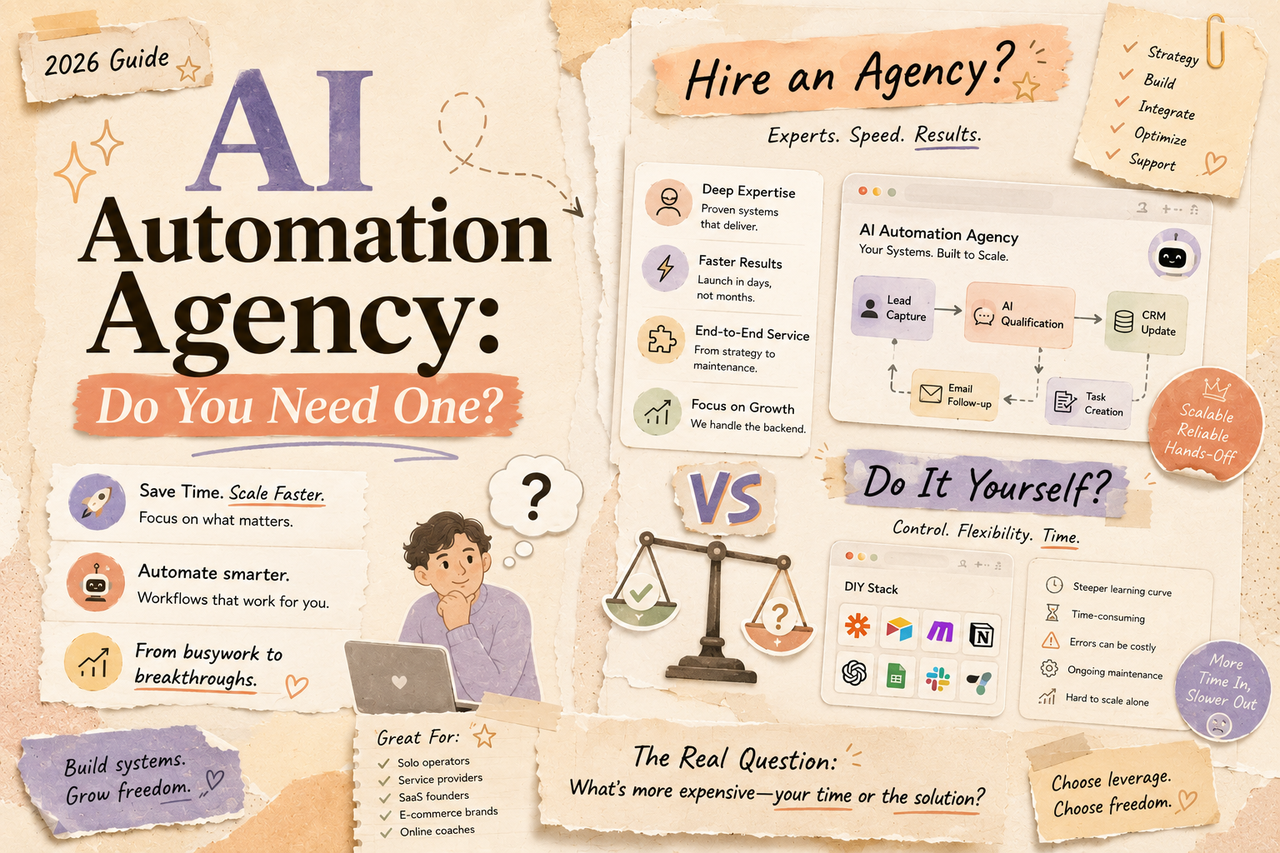
I've sat in a lot of "discovery calls" with AI automation agencies. Some of them were genuinely useful. Others were dressed-up sales decks with no real delivery plan behind them. After going through that process enough times — both as a buyer and as someone helping clients evaluate vendors — I've developed a pretty clear picture of when hiring an agency makes sense, when it doesn't, and what questions actually separate the good ones from the ones who'll leave you with a half-built system and a large invoice.
Let's cut to it.
Quick Verdict: Hire, DIY, or Wait
Before anything else, be honest about where you actually are.
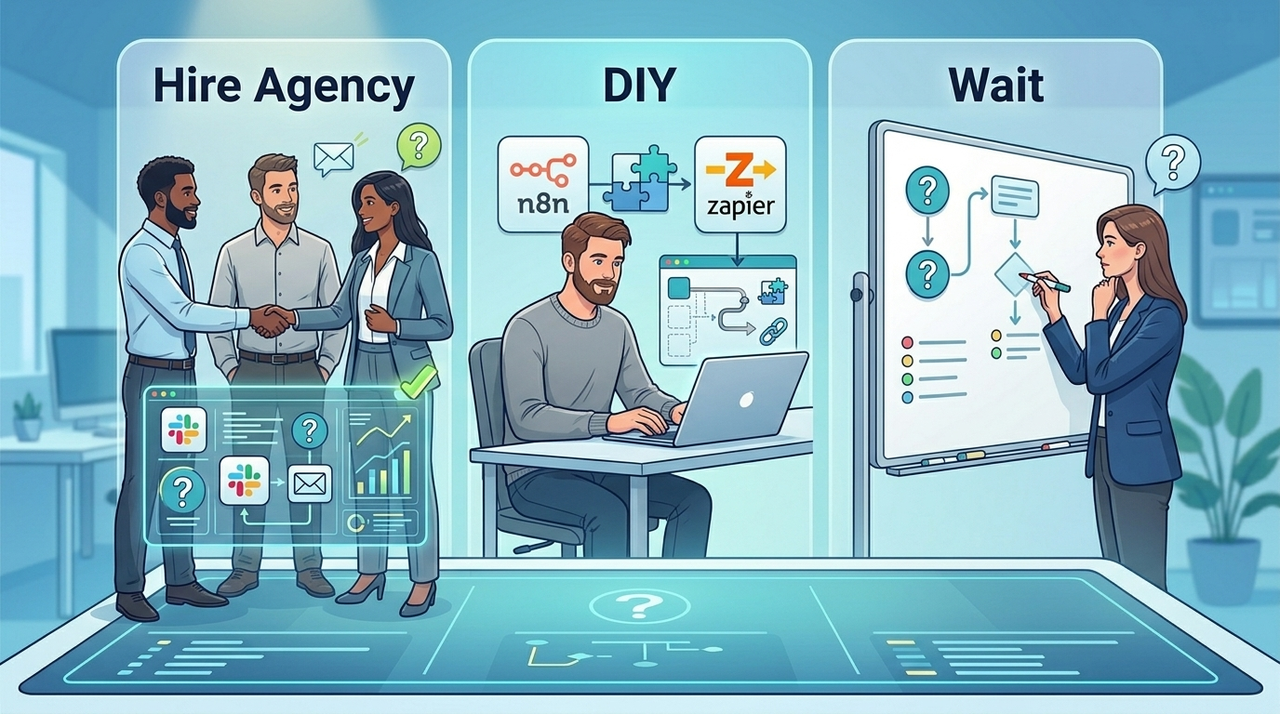
Hire an AI automation agency if: You have a concrete process that's costing you measurable time or money, your team has no capacity to build or maintain the solution internally, and you're willing to invest in proper scoping and handover — not just implementation.
DIY if: Your workflows are well-defined, your team has someone who can commit real hours to building and testing, and the use case is narrow enough to start with a no-code tool or a well-designed prompt. A lot of what agencies sell for $15,000+ can be done with n8n or Make in a weekend, if you know what you're building.
Wait if: You haven't mapped your current processes well enough to know what "automated" would even look like. Bringing in an agency before you understand your own workflows is how you end up paying someone else to figure out problems you should have solved yourself. The discovery phase should sharpen a picture you already have, not paint it from scratch.
One number worth keeping in mind: according to McKinsey research on enterprise AI adoption, companies that have seen 30–40% productivity gains from AI in the first two years typically had clear internal ownership of the problem before any vendor was involved.
What an Agency Should Deliver
Here's where the consulting vs. agency distinction actually matters, and it's one I see blurred constantly.
A consultant advises. They tell you what to build, how to think about it, what the risks are. You leave with a strategy document or a framework.
An AI automation agency — a proper done-for-you one — builds it and hands it over. The deliverable isn't a deck. It's a working system, with documentation your team can actually use, and ideally, a handover that leaves you less dependent on the agency over time, not more.
Workflows, Documentation, Ownership, Training
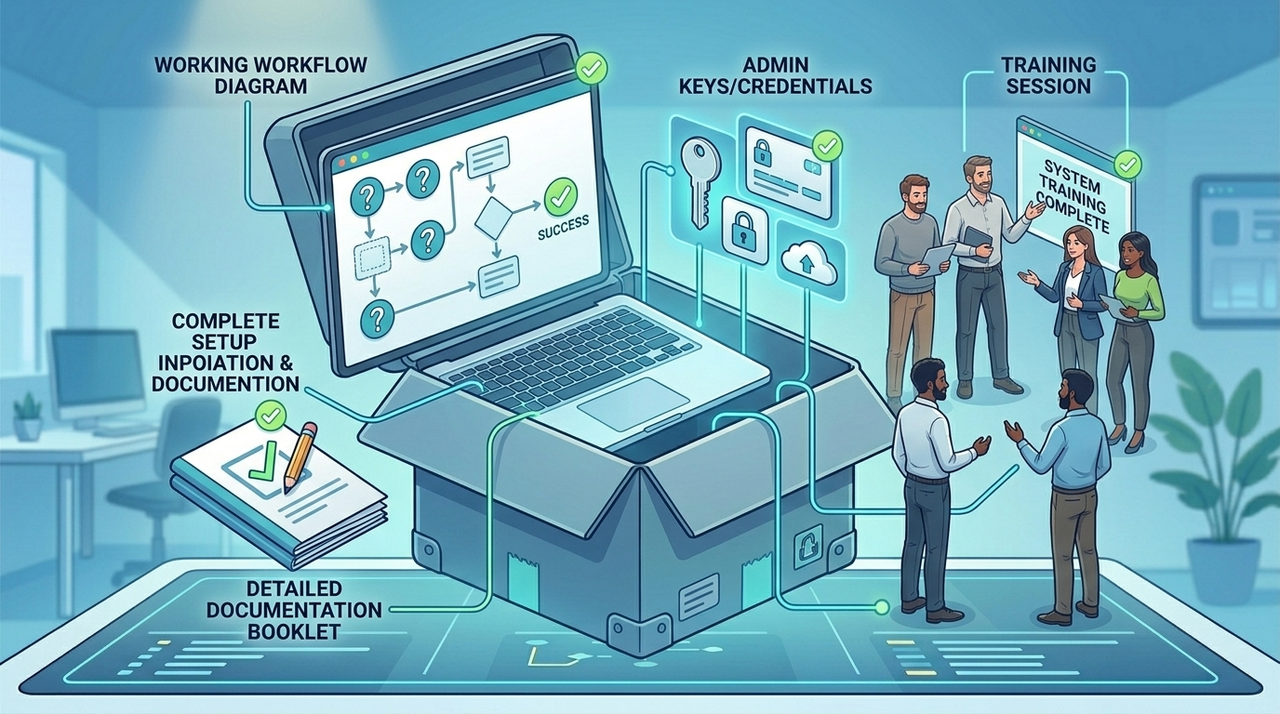
Any reputable ai automation agency should hand over four things at project close:
Working workflows — tested against real data, not just demo inputs. If an agency has never run your actual edge cases through the system, the handover is incomplete.
Documentation — written for your team, not for a developer audience. How does someone on your ops team restart the workflow if it breaks? How do they update a prompt template when your process changes? If the agency can't answer this, they're not done.
Ownership of credentials and code — you should hold the admin keys to every tool involved. Not the agency. Not a shared login. You. AI contract guidance from legal practitioners in 2025 is explicit on this: deliverables, source assets, and prompt libraries should be transferred to the client on handover, and you should own all inputs, prompts, and outputs by default.
Training — at minimum, one session where a real human walks your team through what was built and what to do when something goes wrong.
If an agency's pitch doesn't include all four of these, that's your first red flag.
Where Agencies Are Worth the Cost
Okay — I don't want to be unfairly skeptical. There are genuine scenarios where bringing in an ai automation agency is the right call, and it's worth naming them clearly.
High-volume, high-stakes processes. If you're processing hundreds of documents a week — contracts, invoices, support tickets — and errors carry real cost, the ROI math on a proper implementation is usually fast. One team I worked with automated a three-day invoice reconciliation cycle down to one day after a six-week agency engagement. That's a real number with a real business impact.
Cross-system integrations. Connecting your CRM, your support desk, and your internal database through an automated workflow that handles exceptions gracefully is not easy. If no one on your team has done it before, hiring someone who has is a sensible use of money.
Regulated environments. Healthcare, finance, legal — anywhere that compliance documentation matters, having an agency that understands both the automation layer and the compliance requirements is worth the premium. The alternative is building something that works technically but creates audit problems six months later.
Speed matters more than cost. Sometimes the business case for moving fast outweighs the cost of internal capacity building. If you need something production-ready in eight weeks and your team can't make that happen, a focused agency engagement is the right tool.
Scope, Handover, and Lock-in Risks
This section exists because I've watched good companies get stuck in avoidable situations.
Scope creep is the most common failure mode. An agency starts with "automate your lead qualification workflow" and, three months later, you're building a custom AI platform you didn't ask for. The fix is a tightly scoped statement of work — one workflow, one defined output, one handover date — before any code is written.
Lock-in is a structural risk, not just a contract risk. Analysis of enterprise AI vendor dependency makes this point clearly: if a single vendor controls your code, your credentials, your model access, and your documentation, you don't have automation — you have a dependency. When that vendor raises prices or changes their terms, your operations are at risk. The defense is simple in principle but often skipped in practice: insist on full access to everything before you pay the final invoice.
Proprietary tooling is a yellow flag. Some agencies build on platforms that only they can maintain. That's not inherently wrong — specialized tools can be genuinely better — but you should know going in whether your system will require this agency (or a similar specialist) in perpetuity. Ask directly: "If we needed to migrate this to a different provider, what would that look like?" A confident, honest answer is a good sign. Deflection is not.
Questions to Ask Before the First Call
I'd rather you walk into a sales call over-prepared than under-prepared. Here's what I actually ask:
"Can you show me a handover package from a past project?" Not a case study. The actual documentation they gave the client. This tells you more than any sales pitch.
"Who will own the credentials and accounts at the end of the engagement?" The answer should always be: you.
"What's your process if we want to move away from the tools you've chosen?" A good agency has a real answer. A vendor-dependent agency will hedge.
"What does post-launch support look like — and what does it cost?" Know this before you sign, not after.
"What's been your biggest failure on a project like this?" Agencies that can answer this honestly have usually learned from it. Agencies that can't are either inexperienced or not trustworthy.
The point of these questions isn't to be adversarial — it's to set a professional tone where honest answers are expected. Any agency worth hiring will respect that. Those who bristle at it are telling you something important.
FAQ
What should an agency hand over at the end?
At minimum: working, tested workflows; documentation written for your team (not their developers); admin access to every tool and account involved; and at least one training session. If the system breaks the day after the engagement ends and your team can't diagnose it without calling the agency, the handover was incomplete. Everything they built should be legible to someone on your side.
Should I pay for strategy before implementation?
Sometimes, yes — but with one condition. A paid discovery or strategy phase is worth it when it produces a concrete, scoped implementation plan you can hand to any agency, not just the one who wrote it. If the strategy deliverable is only useful in the hands of the company that created it, you've bought dependency, not clarity. A good strategy phase ends with a document that gives you real choices.
How do I avoid being locked into one vendor?
Three practical moves: First, insist that all credentials, code, and documentation sit in accounts you own — not the agency's. Second, favor open tools (n8n, Make, standard APIs) over proprietary platforms wherever your requirements allow. Third, build a simple internal reference doc for each workflow that explains what it does, what tools it uses, and how to update it. Guidance on AI contract risk management recommends testing your own data portability annually — meaning actually verify that you can export and migrate your setup, not just assume it's possible because the contract says so.
What should be in the contract scope?
Specifically: the workflow(s) being built (named and described), the definition of "done" for each deliverable, who owns credentials and IP at handover, what tools will be used and why, the training component, post-launch support terms and costs, and — critically — a clause on data use. Your data should not be used to train any model without your explicit written consent. White House procurement guidance issued in 2025 includes this as a hard requirement for government contracts; it's a reasonable standard for anyone.
The honest truth about ai automation agency services is that the good ones are genuinely valuable and the mediocre ones are expensive timewasters who leave behind systems nobody on your team can maintain. The difference usually isn't visible in the sales process — it shows up in the handover. So before you sign anything, ask to see what the handover looks like. That single ask will tell you more than an hour of demos.
Previous Posts:
Most solo founders don’t need a custom AI platform — they need a clearer workflow first. Here’s how AI workflow design actually scales without creating operational chaos — AI workflow for solo founders
Before hiring an agency to automate everything, understand the difference between workspace agents, workflow builders, and where each one actually fits — workspace agents vs workflow builders
A lot of “AI automation” problems are really context-switching problems inside fragmented systems — this is the operational bottleneck most teams miss — stop context switching with workspace agents
If you’re evaluating AI vendors, this breakdown of AI workspace agents explains where the category genuinely helps — and where it still creates more setup overhead than value — AI workspace agents explained
The best AI systems for solo operators usually start small: one workflow, one repeated task, one measurable bottleneck — not a giant autonomous stack from day one — AI agents for solo operators
Get automation tips for your workflow
Weekly insights for non-technical professionals. No spam ever.