
AI Agent vs Chatbot: What's the Actual Difference?
AI agent vs chatbot — not the same thing, even if both use AI. Here's how they actually differ and when each one is the right fit.
Hey, I'm Nova — a creator who spends way too much time testing AI tools and writing about what actually happens when you use them. I've been exploring AI tools for a while now, and I'll admit — these two terms tripped me up for longer than I'd like to say. If you've ever used "AI agent" and "chatbot " like they mean the same thing, you're not alone. Let's clear that up.
Why These Two Terms Keep Getting Confused
Here's the thing. Both chatbots and AI agents talk to you in natural language. Both run on large language models. Both feel pretty smart on the surface. So it makes complete sense that people use the terms interchangeably — I did it too.
But then I started building small AI workflows for my own projects, and I kept hitting a wall. I'd ask a chatbot to "research this topic, summarize the key points, and save it as a doc." It would give me a genuinely solid summary. And then just… stop. No file. No saved doc. Nothing happened beyond the words on screen.
That gap — between getting an answer and actually getting something done — is exactly where the ai agent vs chatbot distinction starts to matter. Once you see it clearly, it's hard to unsee.
What Chatbots Are Built to Do
Input → Output, Limited Memory, No External Actions
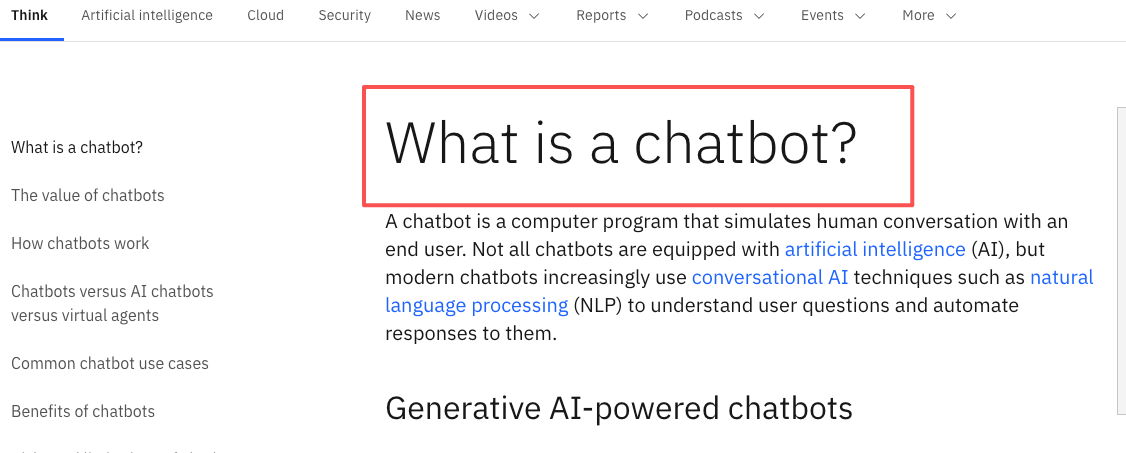
A chatbot is fundamentally a text-in, text-out system. You send a message, it generates a response, loop closed. According to IBM's overview of chatbot technology, even modern AI-powered chatbots using natural language processing are designed primarily to respond — not to act. The architecture is reactive by design: wait for input, process it, return output.
Memory is the other big constraint. Within a single conversation, a chatbot can track context reasonably well. But start a new session, and it's like you never met. No recall of past decisions, no continuity between days. Just a fresh slate every time.
Where Chatbots Still Work Well
This isn't a knock. For a huge range of everyday tasks, a chatbot is exactly what you need — and honestly, better than an agent:
Customer support — answering FAQs, handling returns, routing basic queries
Quick Q&A — explaining a concept, translating a paragraph, summarizing a document
Drafting and editing — writing a cold email, reworking a sentence, generating a first draft
The core pattern here: the task ends at the answer. You want a response, not a sequence of actions. As soon as the task requires more than one step or touching an external system, you're already asking for something a chatbot wasn't designed to handle.
What AI Agents Are Built to Do
Multi-Step Reasoning and Task Execution
An AI agent works differently at its core. Instead of just generating a response to your input, it plans a sequence of steps to accomplish a goal — and then executes them.
You give it a high-level objective: "find the top five competitors in this space, compare their pricing, and put it in a table." It figures out what to do next, takes action, checks the result, and adjusts if something goes wrong. According to Anthropic's research on building effective agents, the most successful implementations use simple, composable patterns — with agents dynamically directing their own processes and tool usage to accomplish open-ended tasks. That "observe, think, act" loop is what makes an agent feel so different from a chatbot. It's not answering. It's doing.
Tool Use, Memory, Context Across Sessions
The real unlock is tool access. Agents can call APIs, read and write files, search the web, run code, send messages, operate browsers. The output isn't just words — it's actions taken inside real systems.
Memory is the other piece. Agents can store context across sessions, recall past decisions, and build up knowledge over time. That's what makes "pick up where we left off" actually possible. As OpenAI's practical guide to building agents describes, agents execute workflows end-to-end and are well-suited for use cases involving complex decisions, unstructured data, or tasks that require reasoning through ambiguity — exactly the conditions where chatbots start to struggle.

Key Differences Side by Side
This is the most important part of the whole piece. Keep it close.
Dimension | Chatbot | AI Agent |
|---|---|---|
Capability scope | Single-turn Q&A | Multi-step task execution |
Memory | Within session only | Persistent across sessions |
Tool use | None — output only | APIs, files, browsers, code |
Autonomy | Responds when prompted | Plans and initiates steps independently |
Typical use case | Customer support, FAQ, drafting | Research, coding, automated workflows |
Input → Output gap | Direct and immediate | Planned and iterative |
One column worth highlighting if you're skimming: tool use. A chatbot produces output. An agent does things with that output. That single difference cascades into almost every other row in the table.
When You Need a Chatbot vs an Agent
My personal rule of thumb: does the task end at the answer, or does it start there?
Ask yourself "what's the difference between REST and GraphQL" — that ends at the answer. A chatbot is perfect. Fast, cheap, zero overhead.
Ask yourself "monitor this competitor's site every morning, summarize new content, and send it to my Slack" — that starts at the answer. There's a loop. There are external systems. There are steps that depend on previous steps. That's an agent task.
There's also a practical cost consideration worth knowing: agents are more expensive to run. Each step in a plan typically requires at least one LLM call. A three-step agent task can easily cost 5–10x more than a single chatbot response. For simple, well-defined queries, that overhead is pure waste.
Two Misconceptions Worth Clearing Up
"ChatGPT Is an AI Agent" — Is It?
Depends entirely on how you're using it. The base ChatGPT interface — for most users, most of the time — is a very capable chatbot. It responds. It doesn't act.
But when you enable tools like web search, code interpreter, or custom GPT Actions, it starts behaving more like an agent. OpenAI describes agents as systems that can reason through ambiguity, take action across tools, and handle multi-step tasks — capabilities that activate only when the model is paired with the right tool integrations. Same underlying model. Different architecture around it. The confusion comes from people seeing ChatGPT use a tool once and assuming the whole product is an "agent." It's not that clean.
"Agents Are Always Better" — Not Necessarily
This one trips people up, especially after scrolling through AI hype on social media. Agents are more complex, slower to respond, and fail in ways chatbots simply can't. They can take actions that are hard to undo, misinterpret multi-step instructions, or get stuck looping.
Anthropic explicitly notes that agentic systems often trade latency and cost for better task performance, and recommends extensive testing in sandboxed environments before deployment. More power means more ways to get it wrong. That's not a reason to avoid agents — it's a reason to choose them deliberately, not by default.
The right framing, according to IBM's analysis of chatbot and agent use cases, is that chatbots, AI assistants, and agents represent different levels of technological sophistication — and the right level depends entirely on the task, not on which sounds more impressive.
FAQ
Q: Is Siri or Alexa a chatbot or an agent? A: A bit of both. They respond conversationally (chatbot-like) and can trigger predefined actions like setting timers or playing music (agent-like). But their action space is limited and fixed — they can't go off-script the way a true AI agent can.
Q: Can a chatbot be upgraded into an agent? A: You can give a chatbot tool access and a goal-oriented prompt, and it'll behave more like an agent. But real agent architectures involve planning loops, error recovery, and memory systems that aren't just bolt-ons to a chatbot setup.
Q: Do I need an agent to build an AI workflow? A: Not always. A well-structured chatbot with scripted logic can handle a surprising amount. Agents are most valuable when the task is open-ended and steps can't be predicted upfront.
Q: Are agents more expensive to run? A: Usually, yes — and often significantly so. If cost matters for your use case, it's worth doing the math before defaulting to an agent just because it sounds more powerful.
Alright, that's the distinction I've been meaning to write out properly. The short version: chatbots handle conversations, agents handle tasks. The line blurs in practice, which is why the terminology gets messy — but the underlying architecture really is different, and knowing which one you need makes a real difference when you're choosing tools or building workflows.
If you're exploring this space too, I hope this made things a little clearer. Back to experimenting.
Previous Posts:
Understand the difference between AI agents and assistants in real workflows.
Explore real-world AI agent use cases across research, content, and operations.
See how one-person businesses are starting to operate like a full team using AI roles.
Learn how AI automation work is actually priced in the real market.
Compare how Lindy and Gumloop differ when building agent-style workflows.
Get automation tips for your workflow
Weekly insights for non-technical professionals. No spam ever.