
AI Agent vs AI Assistant: How They're Actually Different
AI agent vs AI assistant: they sound almost identical but work very differently. Here's a plain-language breakdown of what actually sets them apart.
See you again. Nova is coming~ I'll be honest — for a while, I used these two terms interchangeably. AI agent, AI assistant… I kind of assumed they were just different marketing words for the same thing.
Then I started researching AI workflow tools more seriously. And I kept running into situations where the distinction actually mattered — not in a theoretical way, but in a "I set this up wrong and it didn't do what I thought it would" kind of way.
So I went down the rabbit hole. This is what I figured out — explained the way I wish someone had explained it to me when I started.
Why This Distinction Keeps Getting Blurry
Part of the confusion is real, not just me being slow.
A lot of tools blur the line on purpose — calling things agents when they're really just assistants with a fancier name. And because both run on similar underlying technology (large language models, natural language processing), they can look almost identical from the outside. You type something, something responds. It feels the same.
But under the hood, the difference is meaningful. It comes down to two things: how much autonomy the system has, and how deep its memory goes.
The reason this matters in practice: if you build a workflow assuming something has persistent memory when it doesn't, you'll spend a lot of time re-explaining context that you thought was already there. I did this more times than I'd like to admit before I started paying attention to which category a tool actually belonged to.
What an AI Assistant Actually Does
An AI assistant is reactive. You ask, it answers. You stop asking, it stops.
Think of tools like ChatGPT in its default setup, or Siri, or Google Assistant. You give it a prompt, it gives you a response. Genuinely useful for that — drafting something, answering a question, summarizing a document. But most assistants operate with what researchers call session-scoped memory: they know what you said five messages ago in this conversation, but the moment you close the tab and start a new one, that context is gone.
According to Google's own documentation on conversational AI systems, assistants are designed to handle discrete interactions within a defined session — not to track state across sessions or chain actions autonomously. That's a design choice, not a limitation they forgot to fix.
Where assistants still work well
This isn't a knock on assistants. For a lot of tasks, they're exactly right.
Scheduling, quick Q&A, summarizing a document, drafting a reply — these are things where you want to stay in control of every step. When you define clear parameters, you get consistent, reliable results. Less variance. Fewer surprises.
The practical rule I've started using: if I can describe the task in one or two sentences and I don't need the tool to remember anything from yesterday, an assistant is probably the right fit. The moment I catch myself copy-pasting context from a previous conversation into a new one, that's a signal I might need something else.
What an AI Agent Does Differently
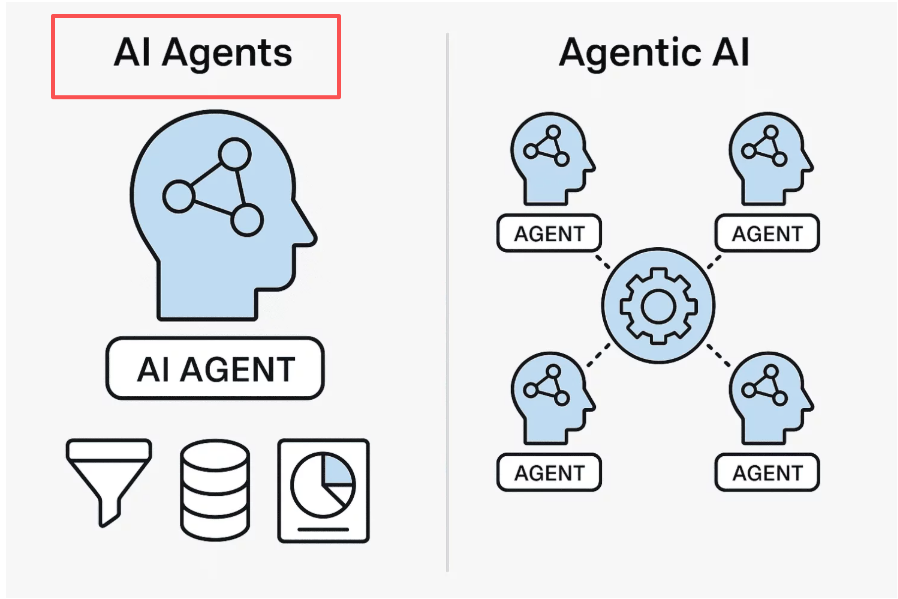
An AI agent is proactive. You give it a goal, and it figures out how to get there.
This is the part that took me a while to fully internalize. An AI agent can autonomously complete tasks by designing its own workflow and using available tools — analyzing problems, breaking them into subtasks, and planning next steps without waiting for you to guide each one.
So instead of you saying "do step 1, now do step 2, now do step 3," you say "here's the end goal" — and the agent works out the path.
IBM's research on AI agent architectures breaks this down in useful technical detail: agents operate through a perception-reasoning-action loop. They observe their environment (inputs, tool outputs, memory), reason about what to do next, and take action — then repeat that cycle until the goal is reached. Some agents can even operate a computer directly — clicking, typing, navigating — to complete tasks on your behalf.
The memory difference is where things get really interesting
Here's where the real depth difference shows up.
Assistants have session memory. Agents need something closer to what researchers call episodic memory — persistent context that spans multiple sessions, goals, and outcomes. According to the LangChain documentation on agent memory types, agent memory systems typically distinguish between short-term (in-context), long-term (external storage), and procedural memory (learned behaviors). Most assistants only have the first kind.
In practice, this means an agent can remember a client's preference from six months ago, or flag that a particular approach didn't work last time and try something different. That's not something you can replicate just by writing a better prompt.
That's closer to a colleague than a search bar. And that's exactly why more solo operators are starting to structure their work . This way — effectively running a one-person business with AI handling the parts that used to require a small team.
Side-by-Side Comparison
This is the part I actually wanted when I started researching. Here it is, as cleanly as I can put it:
Dimension | AI Assistant | AI Agent |
|---|---|---|
Operating mode | Reactive (prompt → response) | Proactive (goal → autonomous steps) |
Memory scope | Session-only | Persistent across sessions |
Tool use | Limited or none | Multi-tool orchestration |
Decision-making | Follows your instructions | Plans and adapts independently |
Human involvement | Required at each step | Required mainly at goal-setting |
Best for | Discrete, well-defined tasks | Multi-step, repeatable workflows |
Error recovery | You notice and correct | Can self-correct within limits |
Setup complexity | Low | Higher upfront investment |
One framing I found useful from Pieces' breakdown of agents vs assistants: using an assistant feels like consulting an expert. Using an agent feels like delegating to a capable colleague. The distinction isn't about intelligence — it's about who's responsible for the next step.
A Real Workflow Example (Where This Actually Showed Up)
I do a lot of content research — pulling from multiple sources, organizing ideas, drafting outlines. For a while I was running this entirely through assistant-style tools. Every session I'd paste in my notes, re-explain the project context, describe what I needed. It worked. It was also slow.
When I started experimenting with agent-style setups — giving the system a standing brief, access to my files, and a defined output format — the difference was immediate. Not dramatic, but real. I stopped re-explaining things. The output started matching my existing style without me prompting for it. The context was just… there.
I spent maybe three hours setting up the initial structure. After that I got that time back probably within a week.
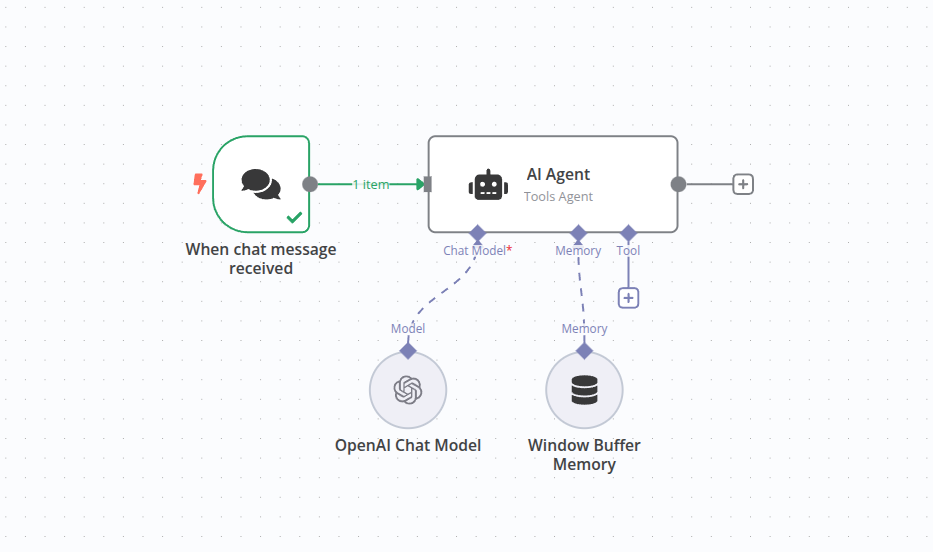
That's not a promise about your experience. It's just what I noticed in mine. Tools like n8n's agentic workflow documentation give a good sense of what the actual implementation looks like if you want to see it spelled out in technical terms.
Which One Do You Actually Need?
Three questions. That's all.
Does your task have more than 3–4 steps that depend on each other? If yes, lean toward an agent. Assistants handle pieces. Agents handle processes. The more steps that need to happen in sequence — especially if earlier steps affect later ones — the more an agentic setup pays off.
Do you need context from past sessions or long-term memory? If you're constantly re-explaining your situation every time you open a new chat, that's a sign you need persistent memory. That's an agent capability, not an assistant capability. No amount of prompt engineering fully compensates for the absence of persistent state.
How much do you want to stay in the loop at each step? If you want control at every decision point, an assistant is safer and more predictable. If you're okay trusting the system to figure out the path — and just want the outcome — an agent makes more sense.
No product recommendations here. Just the framework. The right answer depends entirely on what you're actually trying to do.
Where the Line Is Starting to Blur
Here's the honest part: this distinction is getting messier, not cleaner.
A lot of tools that call themselves "assistants" are quietly adding agentic features — memory, tool use, multi-step execution. And some things called "agents" are basically just fancy chatbots. The MIT Technology Review's coverage of AI agent development tracks this blending of capabilities well — it's one of the clearest trends in the space right now.
The line is also blurring at the architecture level. An assistant could serve as the front-end interface to trigger agent-driven workflows in the backend — a hybrid model where you're talking to something that looks like a simple assistant, but it's actually kicking off an agentic process behind the scenes. Anthropic's research on tool use and agent behavior gives some useful context on how these hybrid architectures are being designed.
What I've started doing: instead of asking "is this an agent or an assistant," I ask — how much does this system remember about me, and how much can it do without me holding its hand? Those two questions cut through the marketing noise pretty well.
FAQ
What's the simplest way to explain the difference?
Assistants respond to what you ask. Agents pursue goals you define. The moment you stop prompting an assistant, it stops working. An agent keeps going — or at least, that's what it's designed to do.
Is ChatGPT an AI assistant or an AI agent?
In its standard form, it's an assistant — reactive, session-scoped memory, no autonomous action. With tools and plugins enabled (including its newer memory features), parts of it can behave more like an agent. The line is genuinely blurry in ChatGPT's case right now.
Can an AI assistant become an agent?
Sort of. Wrapping a language model in frameworks that add memory, tool access, and a reasoning loop — like LangGraph or AutoGen — can shift it toward agentic behavior. But it's an architectural change, not just a setting you toggle. The underlying model is the same; the scaffolding around it is different.
Do I need an agent for solo work or small teams?
Not necessarily. For a lot of creative and writing work, a well-prompted assistant is still the right tool. Agents start making more sense when you have repeatable, multi-step workflows you want to run with less manual involvement — like a research-to-draft pipeline, or automated file organization, or anything where the same sequence of steps happens more than a few times a week.
Why do companies keep using these terms interchangeably?
Mostly marketing. "Agent" sounds more impressive than "assistant," so a lot of tools reach for that label. The Stanford HAI 2025 AI Index Report is worth reading if you want a more rigorous framework for how researchers actually evaluate and categorize these systems — it's a useful reality check against the marketing.
Anyway — that's my understanding of it right now. Still learning. But at least the next time someone mentions "deploying an AI agent," I won't just nod along and secretly have no idea what makes it different from a chatbot.
If you're exploring this stuff too, hopefully this saves you some of the time I spent going in circles.
Related posts:
Get automation tips for your workflow
Weekly insights for non-technical professionals. No spam ever.