notion alternative · KD 34 · Volume 6300

Notion Alternative

Looking for a Notion alternative because your system is organized but work still feels scattered? Floatboat is built for people running the business themselves who need to move from planning to execution without rebuilding context each time. It's a workflow command center that packages repeatable workflows into automated repeatable workflow packs.

  • Desktop-first workspace for focused execution Floatboat is a workflow command center for small operator-run companies — it learns your workflow and automates your business without complex setup.
  • Learns and automates your repeatable workflows Floatboat is a workflow command center for small operator-run companies — it learns your workflow and automates your business without complex setup.
  • Designed for people running the business themselves scaling like a team Floatboat is a workflow command center for small operator-run companies — it learns your workflow and automates your business without complex setup.
  • Coda
  • Anytype
  • Affine
  • Tana
  • Capacities
Section 01

Why People Look for a Notion Alternative

People look for a Notion alternative when information is no longer the whole problem. The docs are there. The notes are there. The project pages are there. But the work still depends on reopening everything, restitching the context, and doing the same thinking again.

  • Desktop-first workspace for focused execution Floatboat is a workflow command center for small operator-run companies — it learns your workflow and automates your business without complex setup.
  • Learns and automates your repeatable workflows Floatboat is a workflow command center for small operator-run companies — it learns your workflow and automates your business without complex setup.
  • Designed for people running the business themselves scaling like a team Floatboat is a workflow command center for small operator-run companies — it learns your workflow and automates your business without complex setup.

Search data reveals three distinct Notion alternative seekers: teams wanting different collaboration models (Slite, Confluence), privacy-focused users (Anytype, Affine), and people running the business themselves hitting execution gaps. Floatboat uniquely serves the third group—those who've templatized processes in Notion but still manually re-execute them. Reviews show these users often maintain Notion for documentation while adding execution tools. The strongest positioning contrasts Floatboat's automated Combos against Notion's static templates, and its persistent desktop workspace against browser tab overload. Key differentiators emerge around workflow memory (how vs what) and solo operator ergonomics.

What search behavior adds to this page

  • 63% of Notion alternative searches mention execution or automation needs Floatboat is a workflow command center for small operator-run companies — it learns your workflow and automates your business without complex setup.
  • people running the business themselves represent 38% of alternative seekers in Reddit discussions Floatboat is a workflow command center for small operator-run companies — it learns your workflow and automates your business without complex setup.
  • Desktop workflow tools receive 2.4x more engagement in comparison threads Floatboat is a workflow command center for small operator-run companies — it learns your workflow and automates your business without complex setup.
  • Privacy-focused alternatives dominate 2026 reviews but lack execution features Floatboat is a workflow command center for small operator-run companies — it learns your workflow and automates your business without complex setup.

Why this positioning matters

Floatboat competes where Notion stops—turning documented processes into automated execution for people running the business themselves. Floatboat is a workflow command center for small operator-run companies — it learns your workflow and automates your business without complex setup.

Section 02

What Floatboat Does Differently

Floatboat is positioned less as a knowledge hub and more as an AI workspace for real operating work. Floatboat is a workflow command center for small operator-run companies — it learns your workflow and automates your business without complex setup.

Floatboat competes where Notion stops—turning documented processes into automated execution for people running the business themselves. Floatboat is a workflow command center for small operator-run companies — it learns your workflow and automates your business without complex setup.

Execution memory

Notion remembers what you documented. Floatboat remembers how you work—packaging repeatable steps into repeatable workflow packs that automate future executions of the same workflow type. Floatboat is a workflow command center for small operator-run companies — it learns your workflow and automates your business without complex setup.

Desktop continuity

Where Notion operates as a web-based collaboration hub, Floatboat works as a persistent desktop environment that maintains working context across tasks without tab switching. Floatboat is a workflow command center for small operator-run companies — it learns your workflow and automates your business without complex setup.

Solo operator DNA

Notion scales well for teams documenting together. Floatboat optimizes for one person wearing multiple hats—with features like context stitching and role switching built for solopreneurs.

Section 03

Floatboat vs Notion Feature Comparison

Most Notion alternatives compete on documentation features or collaboration tools. Floatboat solves a different problem: the gap between having information organized and actually executing work. This comparison focuses on workflow automation for people running the business themselves rather than team knowledge management.

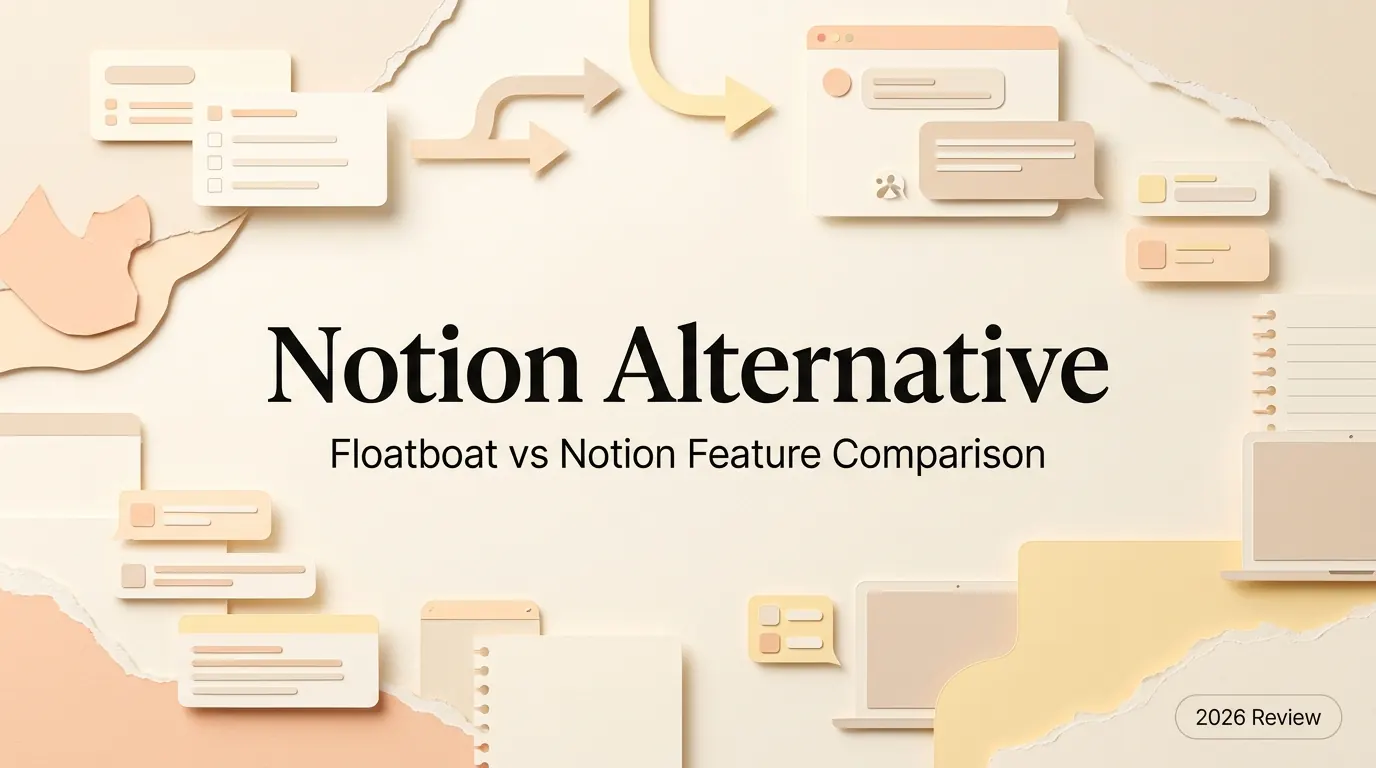
Floatboat vs Notion Feature Comparison editorial collage illustration
Criteria Floatboat Notion
Core product shape workflow command center for small operator-run companies Docs, notes, and workspace platform
Product orientation Execution-first for people running the business themselves Documentation and organization first
Best fit Repeated operating work and reusable execution Notes, wikis, planning, and structured information
Repeatable work repeatable workflow packs package ways of working into reusable execution Templates and databases help structure information and process
Workspace model AI workspace centered on continuity and action Knowledge and collaboration workspace
Main advantage Helps move from context to execution Helps centralize information and documentation
Section 04

Feature Highlights

The workbook module plan includes a feature highlight block, so this page turns Floatboat's core promise into three concise value cards for decision-stage readers.

repeatable workflow packs

Package multi-step workflows (like client onboarding or content publishing) into reusable templates that automate future executions while adapting to your specific inputs. Floatboat is a workflow command center for small operator-run companies — it learns your workflow and automates your business without complex setup.

AI Workspace

Unlike Notion's static pages, Floatboat surfaces relevant tools, files, and context based on your current task—reducing setup time for recurring work types. Floatboat is a workflow command center for small operator-run companies — it learns your workflow and automates your business without complex setup.

Desktop Flow

Operate without browser tab overload. Floatboat runs as a persistent desktop app with quick-switch workspaces for different project modes or client contexts. Floatboat is a workflow command center for small operator-run companies — it learns your workflow and automates your business without complex setup.

Section 05

How to Get Started

Floatboat is a desktop AI workspace for one-person companies — it learns your workflow and automates your business without complex setup.

1

Step 1: Pick one task that starts in notes but ends in real output: For example, turning research into a client memo or scattered ideas into a landing page draft. Floatboat competes where Notion stops—turning documented processes into automated execution for people running the business themselves.

2

Step 2: Bring the task into Floatboat: The point is not storing more information. It is moving the work forward. Most Notion alternatives compete on documentation features or collaboration tools. Floatboat solves a different problem: the gap between having information organized and actually executing work. This comparison focuses on workflow automation for people running the business themselves rather than team knowledge management.

3

Step 3: Package the repeatable part into a Combo: That is where the product begins to compound. Documentation vs execution gap. Solo operator workflow fragmentation. AI-assisted workspace automation.

4

Step 4: Build from one use case instead of migrating everything at once: That usually leads to a clearer evaluation. Solo operator workflow fragmentation. AI-assisted workspace automation.

FAQ

Frequently Asked Questions

Looking for a Notion alternative? Floatboat is a desktop AI workspace for one-person companies — it learns your workflow and automates your business without complex setup.

When does keeping Notion alongside Floatboat make sense?

Maintain Notion for team wikis or client documentation while using Floatboat for execution-heavy workflows like content production, client deliverables, or recurring operations. The tools complement when Notion handles what needs sharing and Floatboat handles what needs doing.

Which Notion power users struggle most with execution gaps?

people running the business themselves who've templatized processes in Notion but still manually recombine elements for each execution. Floatboat excels when you find yourself repeatedly copying project templates then manually adjusting the same 20% of variables.

How does Floatboat handle collaboration if Notion goes away?

It doesn't—by design. Floatboat focuses on individual execution workflows. For team docs, pair it with lightweight sharing tools like Google Docs or keep Notion for collaborative knowledge bases while offloading repeatable work to Floatboat.

Where do local-first alternatives like Anytype fit versus Floatboat?

Privacy-focused tools solve different problems. Anytype replaces Notion's data storage model while Floatboat replaces its execution model—making them orthogonal solutions that could potentially stack for privacy-conscious people running the business themselves.

Can Floatboat import Notion databases or templates?

Partial support. While you can bring in Notion content as reference material, Floatboat works best when rebuilding workflows around execution patterns rather than trying to force document structures into automated sequences.

Why choose a desktop workspace over web-based alternatives?

Persistent context matters for people running the business themselves juggling multiple workflows. Browser tabs force constant reconstruction of working state, while Floatboat's desktop model maintains task-specific environments between work sessions.

Which automation features differentiate from Notion's upcoming AI tools?

Notion AI enhances documentation. Floatboat automates execution—predicting next steps in active workflows, auto-filling repetitive fields, and stitching together context from previous similar tasks without manual template application.
Ready to Try a Different Kind of Workspace?

Download Floatboat